Diary
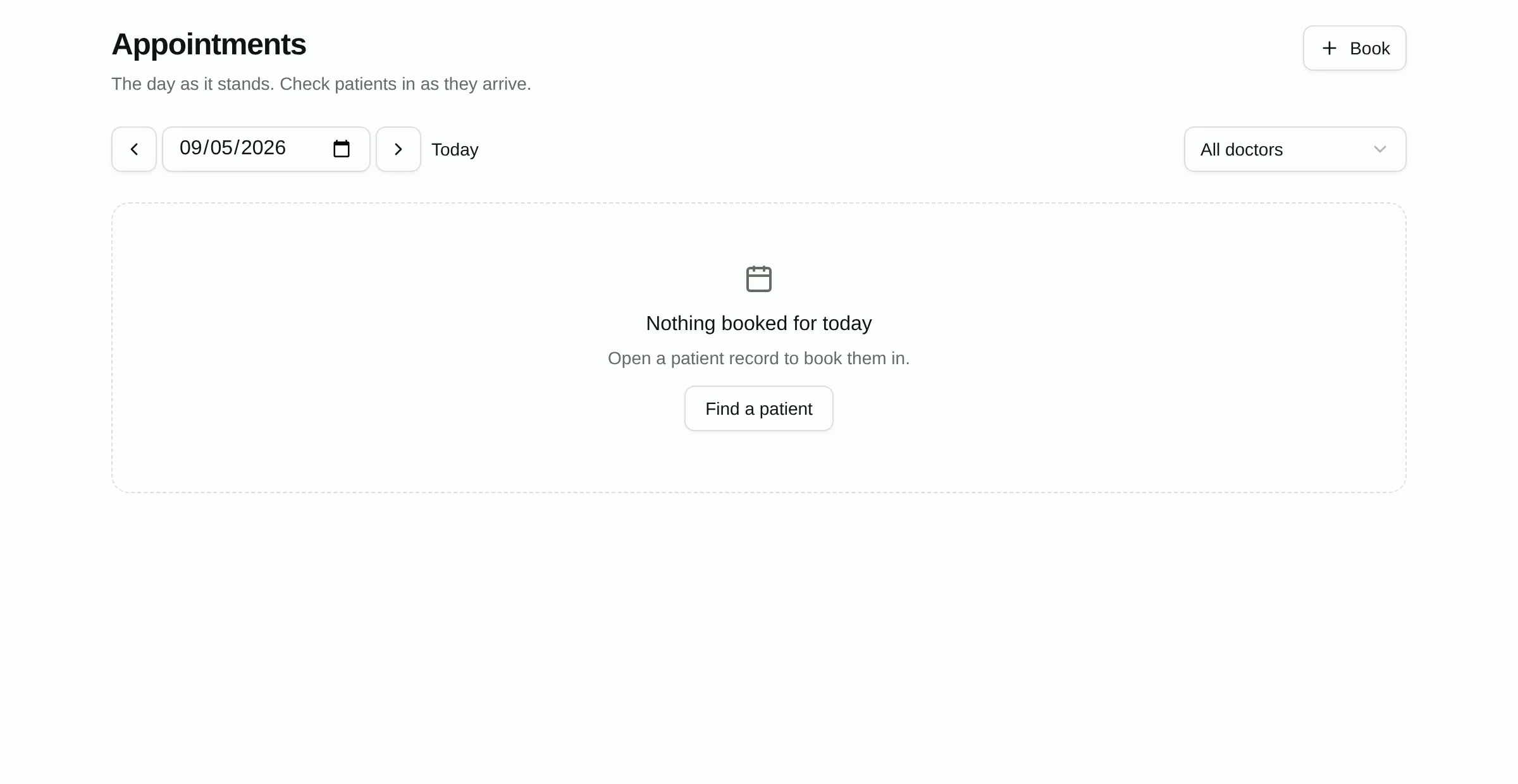
Book by doctor and room, see the whole day at a glance, and let the database refuse double-booked slots rather than trusting everyone to notice.
- Per-doctor columns
- Overlap prevented at the database
- Walk-ins alongside bookings
Clinic software for India
Appointments, the waiting queue, consultations, prescriptions, GST billing, pharmacy stock and lab reports. One login, one record, no double entry.
A day in the clinic
Most clinic software makes you enter the same patient three times — once to book, once to prescribe, once to bill. Here the record moves with the patient.
9:10 am
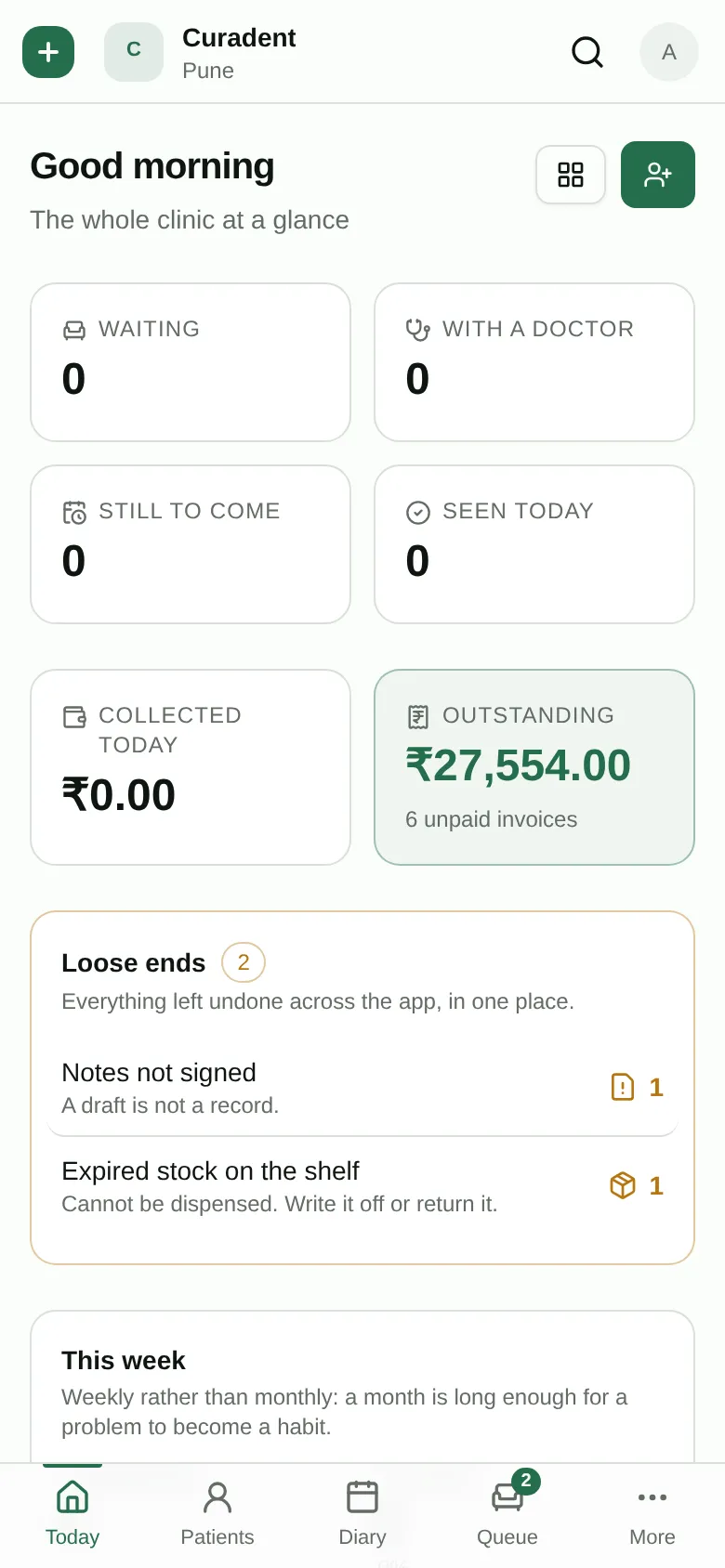
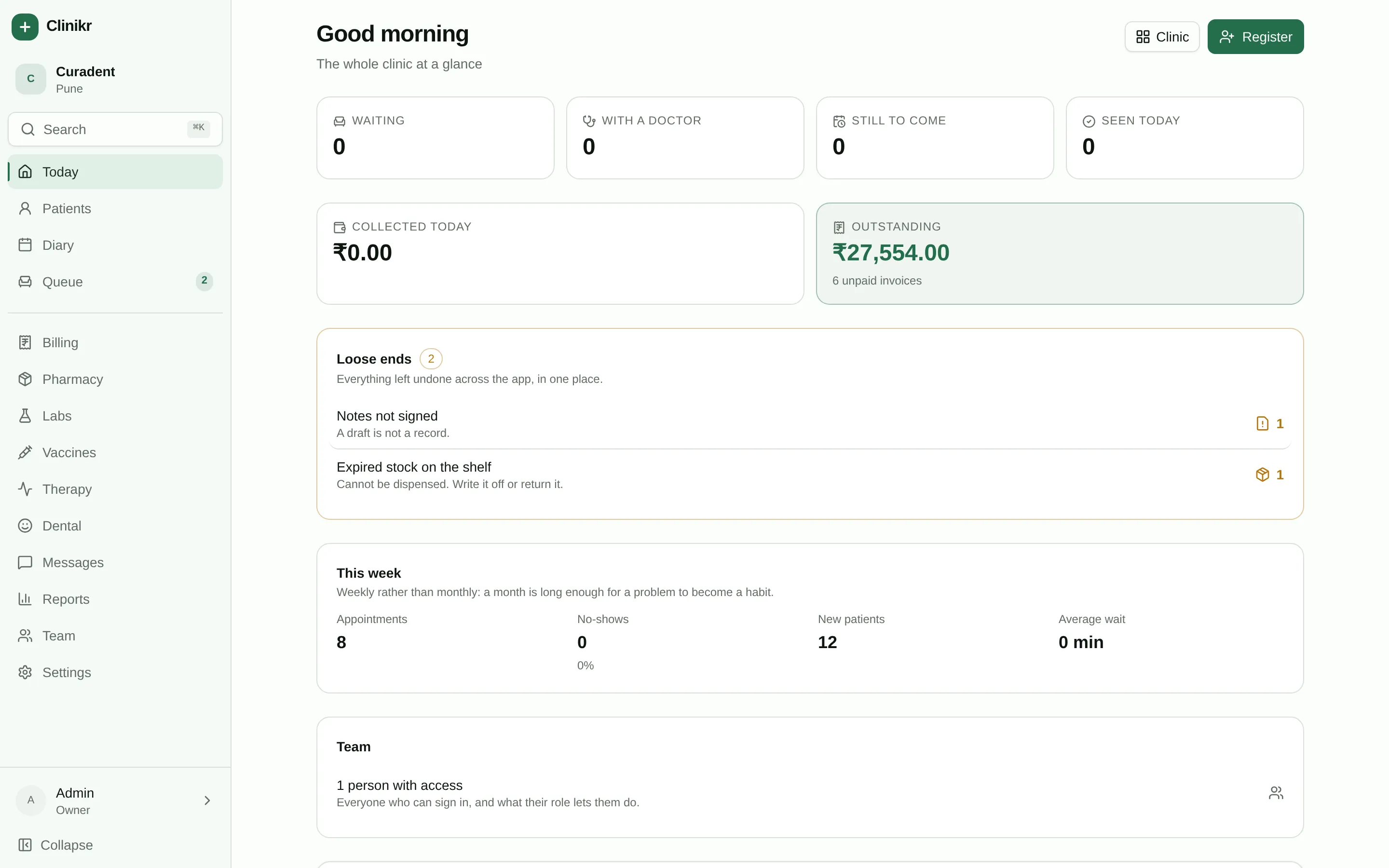
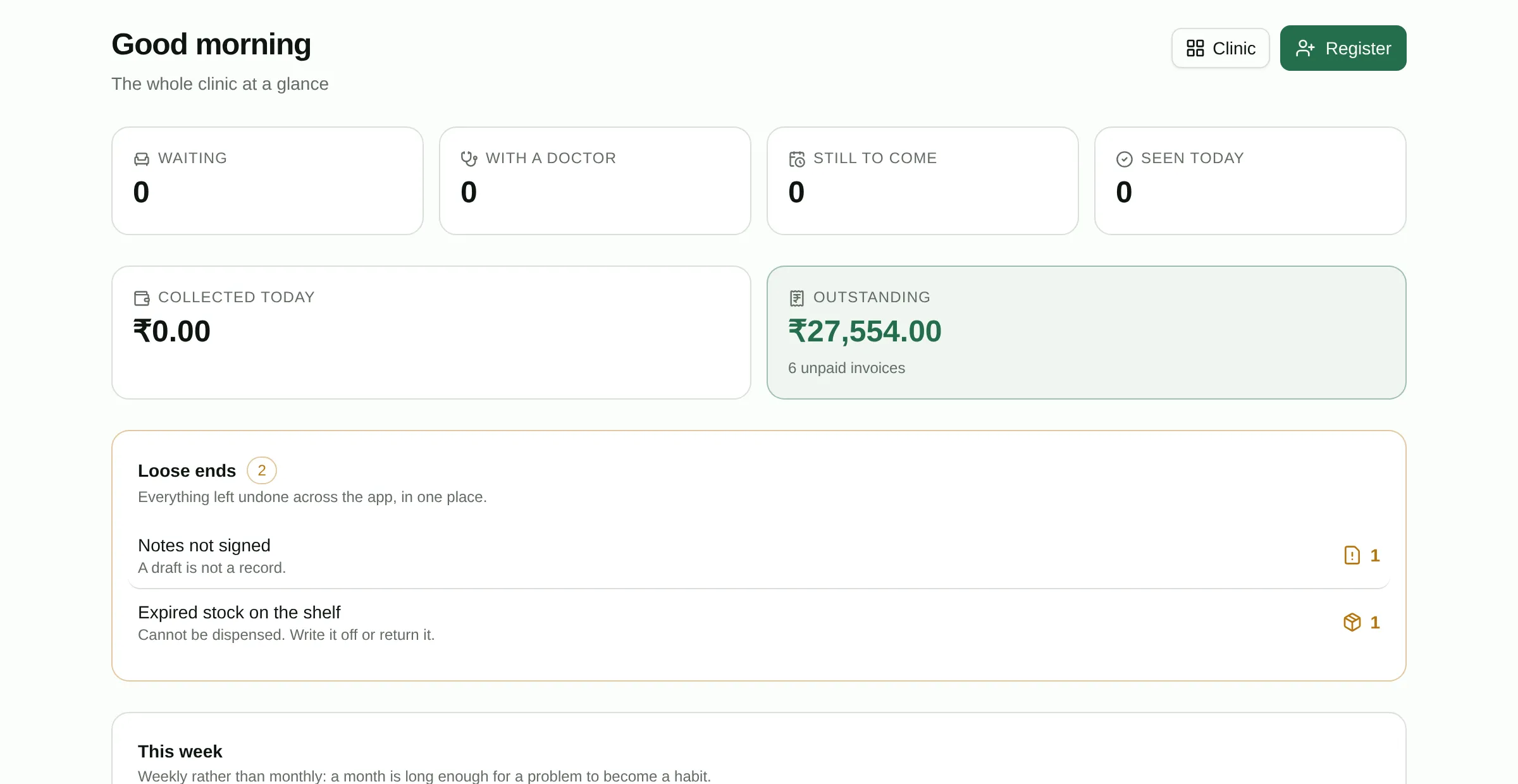
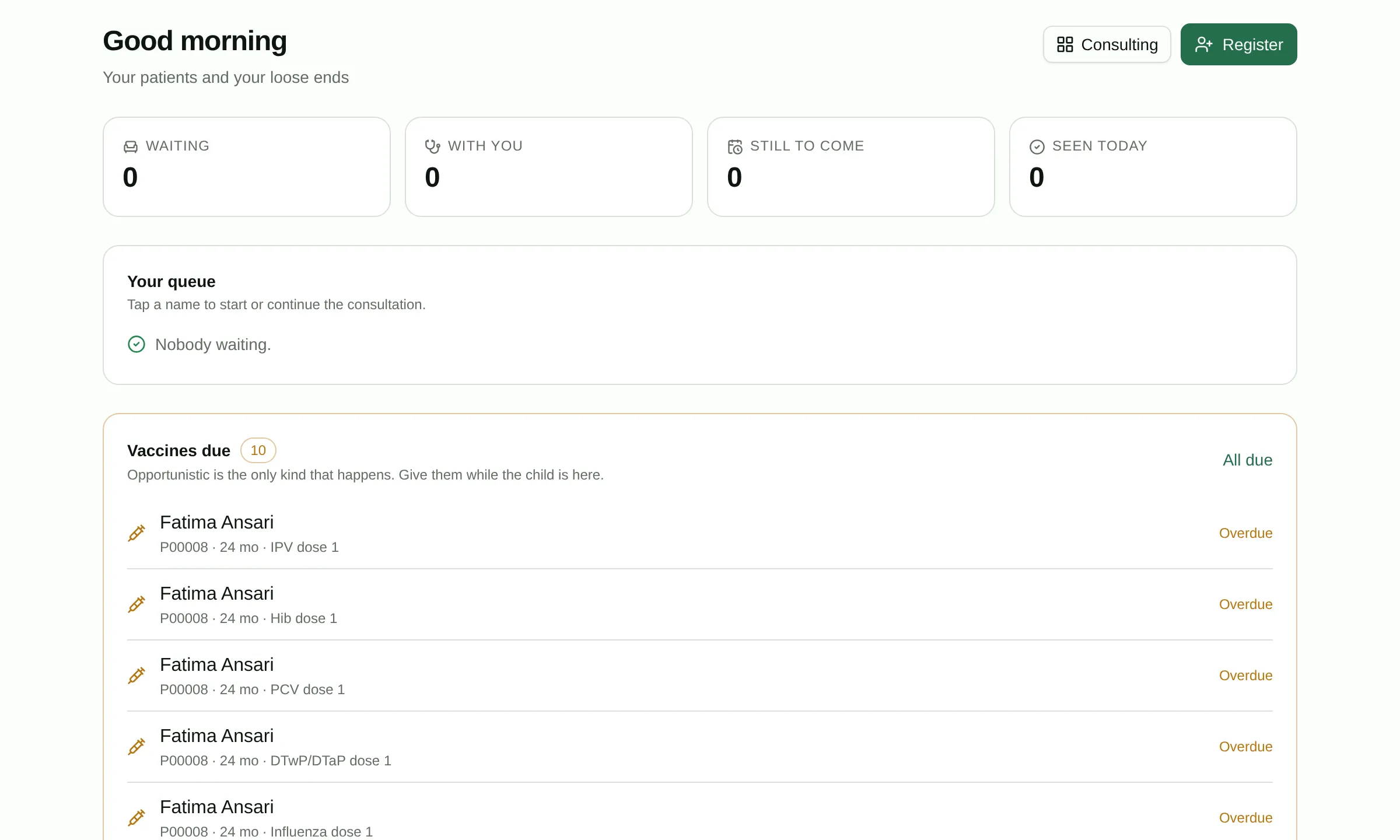
Today opens on the only three things that matter before the first patient: who is waiting, what is booked, and what has been collected. No dashboard to configure.
Today
9:24 am
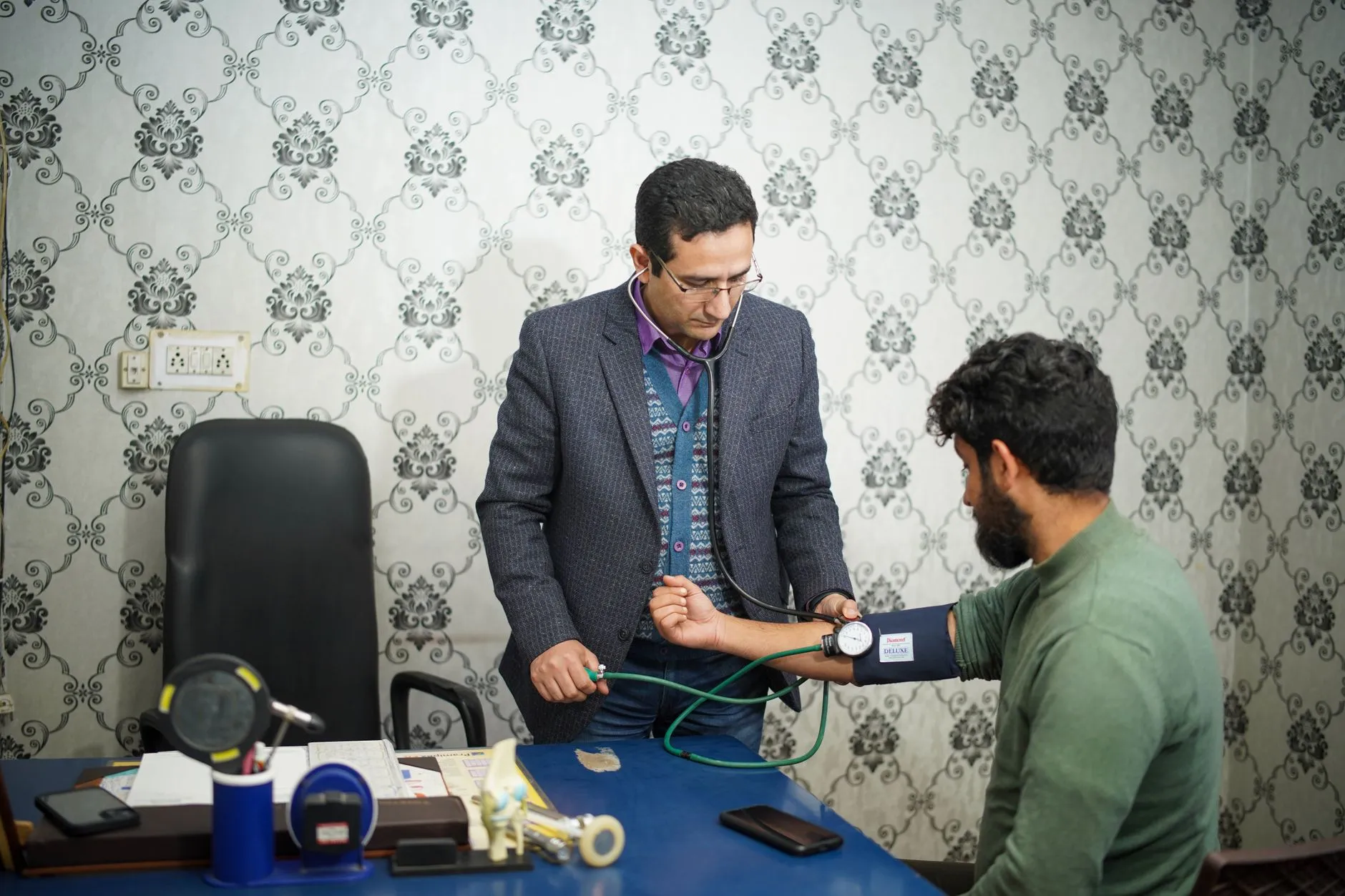
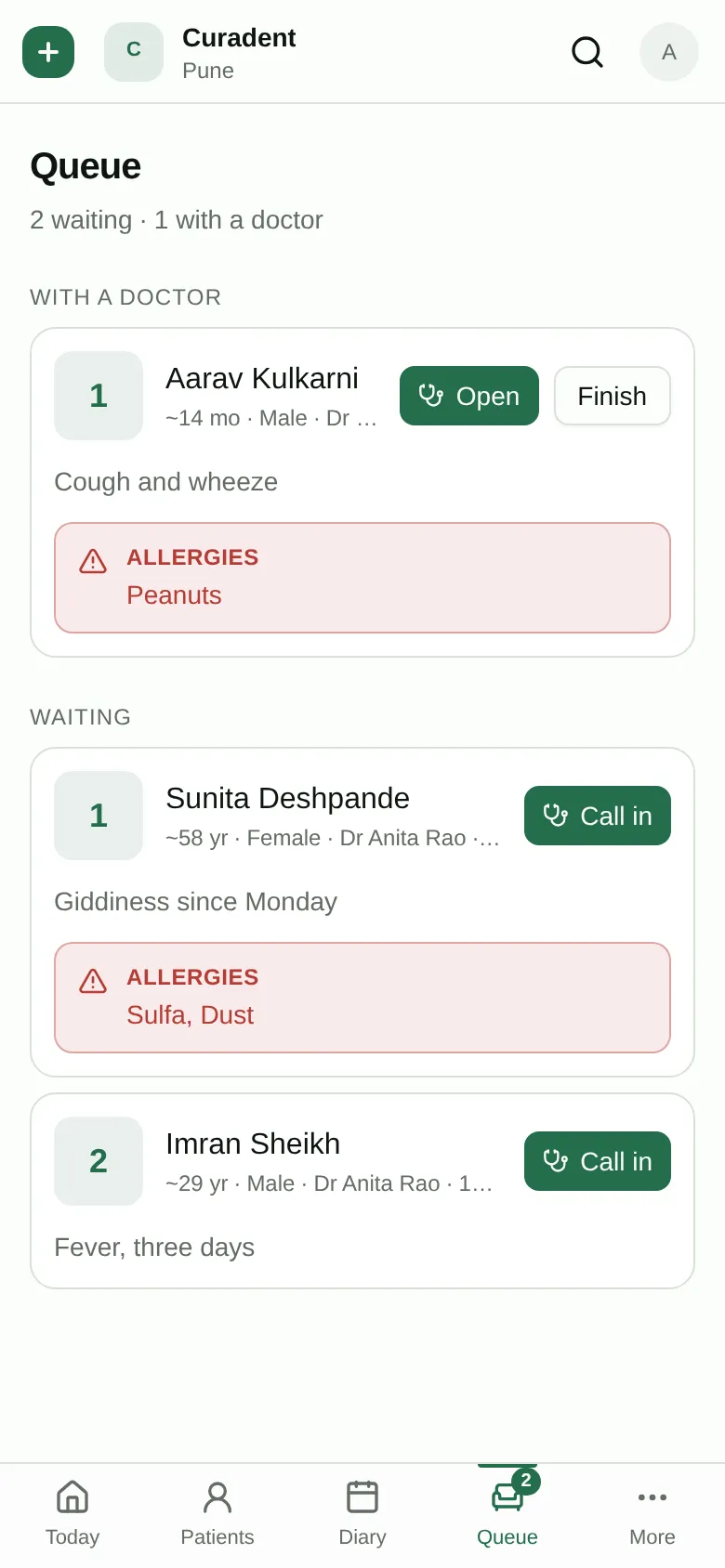
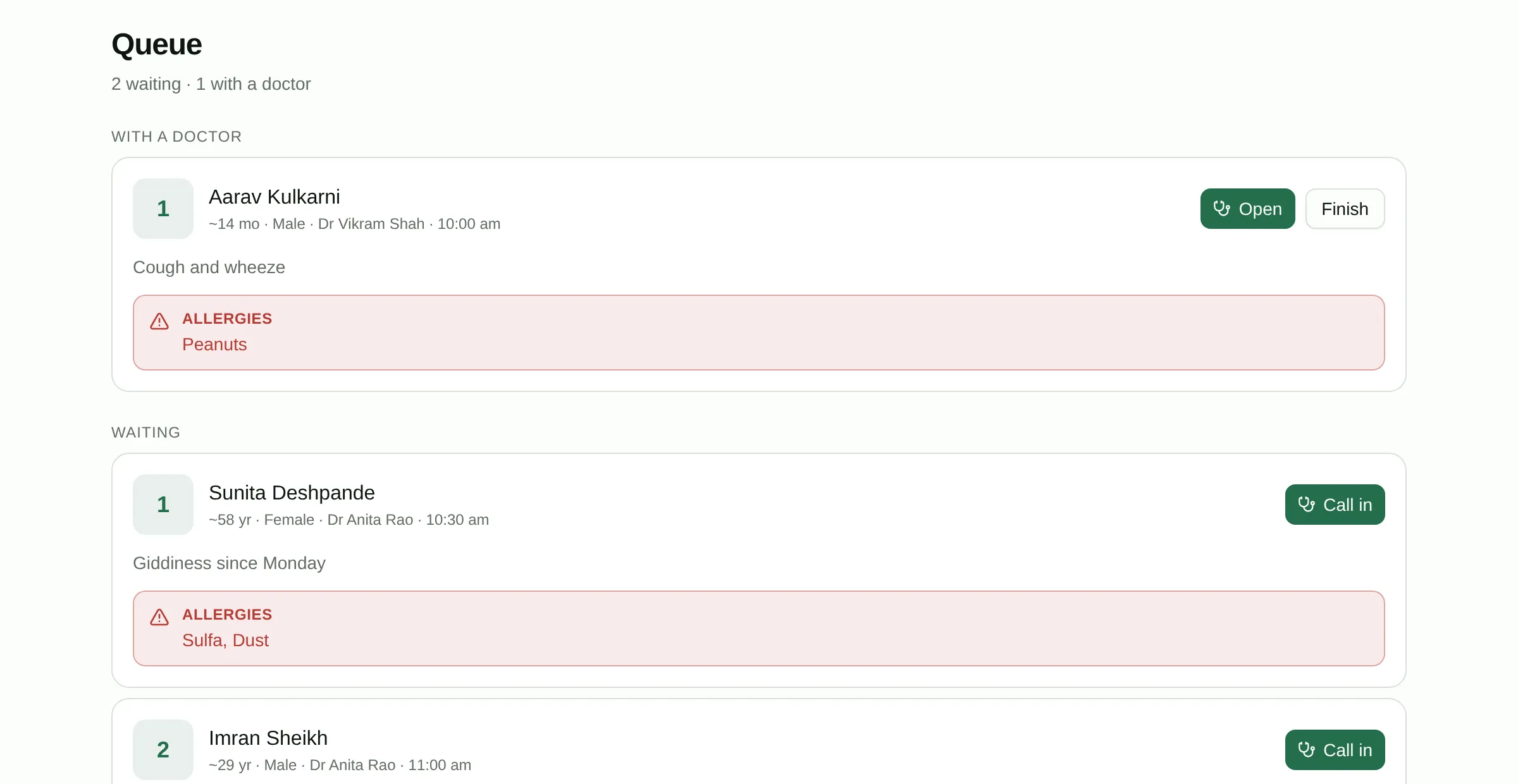
The front desk checks a patient in and the doctor’s queue updates instantly — no refresh, no shouting down a corridor. Walk-ins slot in beside booked appointments.
Queue
9:31 am
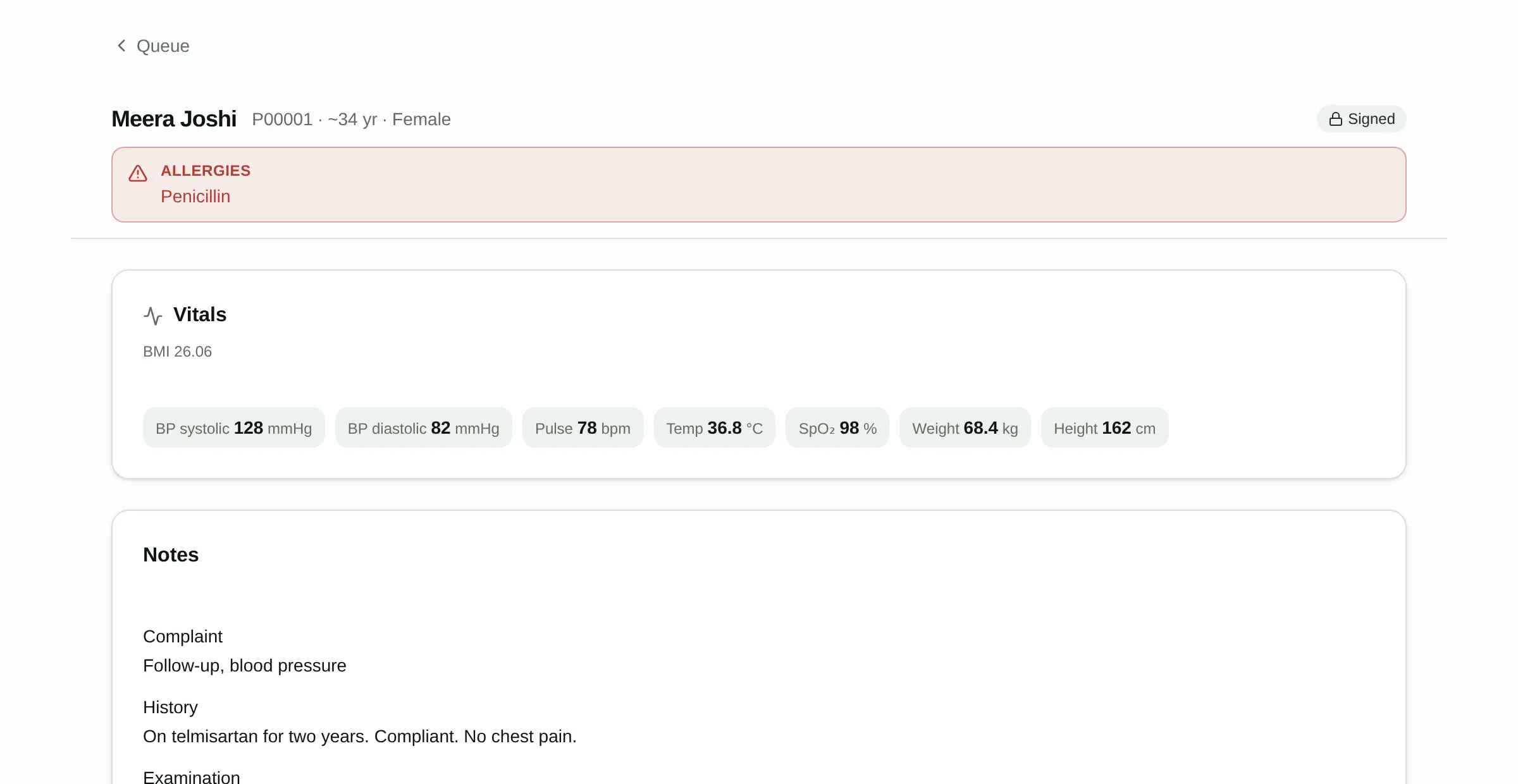
Allergies sit at the top where they cannot be missed. Sign the encounter and it is locked — an amendment is a new, dated note, never a quiet edit of the old one.
Consultation
9:48 am
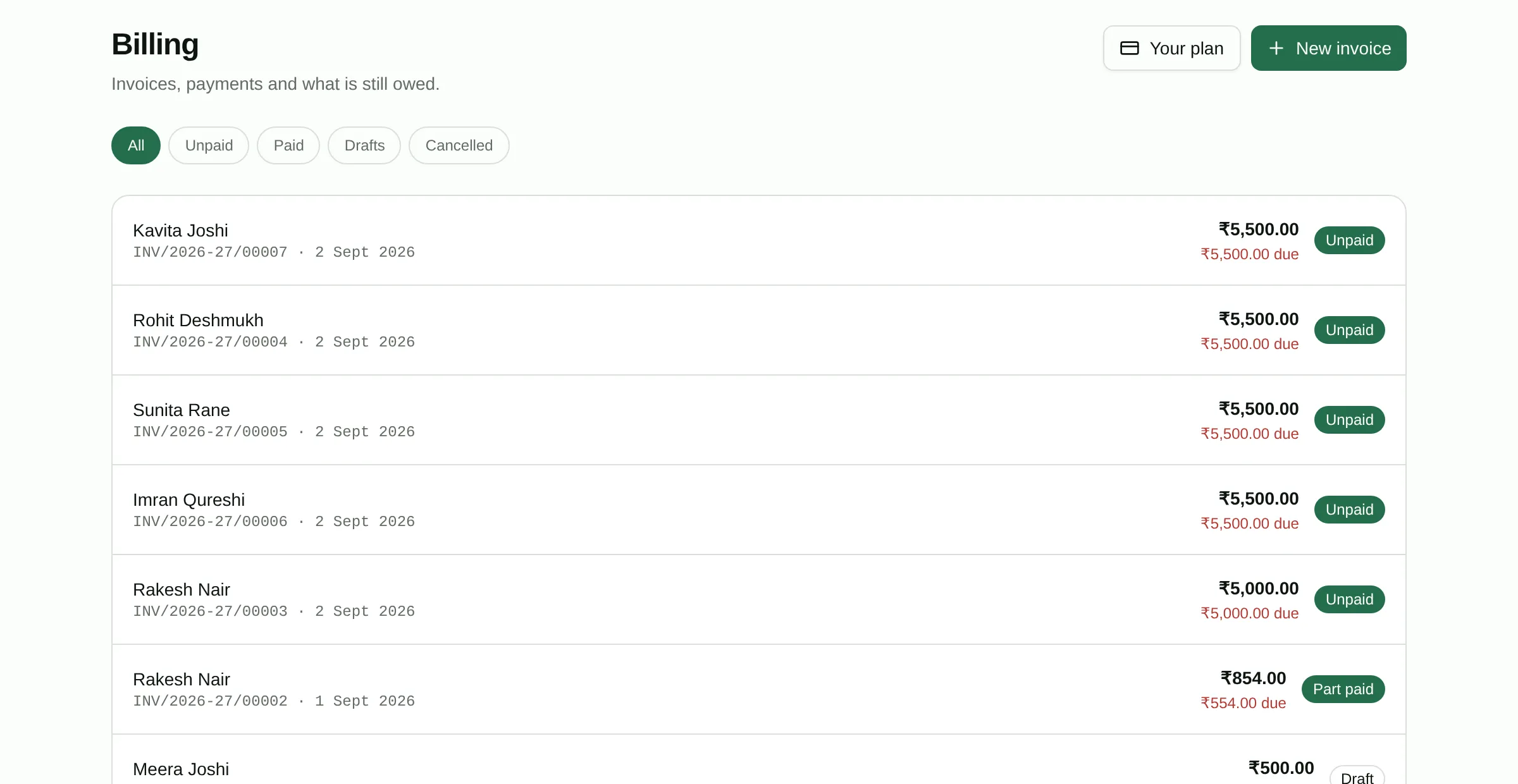
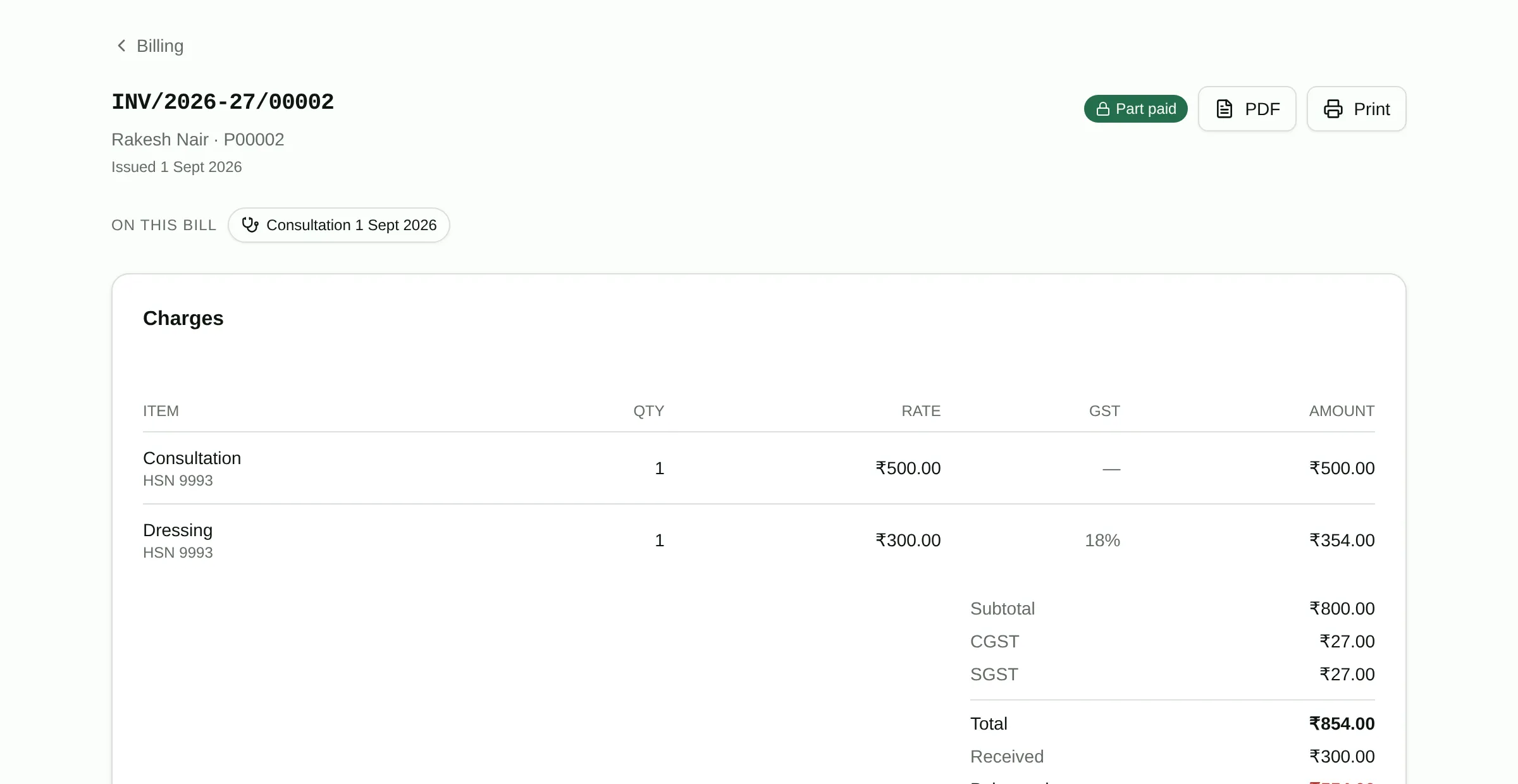
Bill straight from the consultation. Line items, GST and totals are computed on the server, so two people on two devices can never disagree about the amount.
Invoice
Next visit
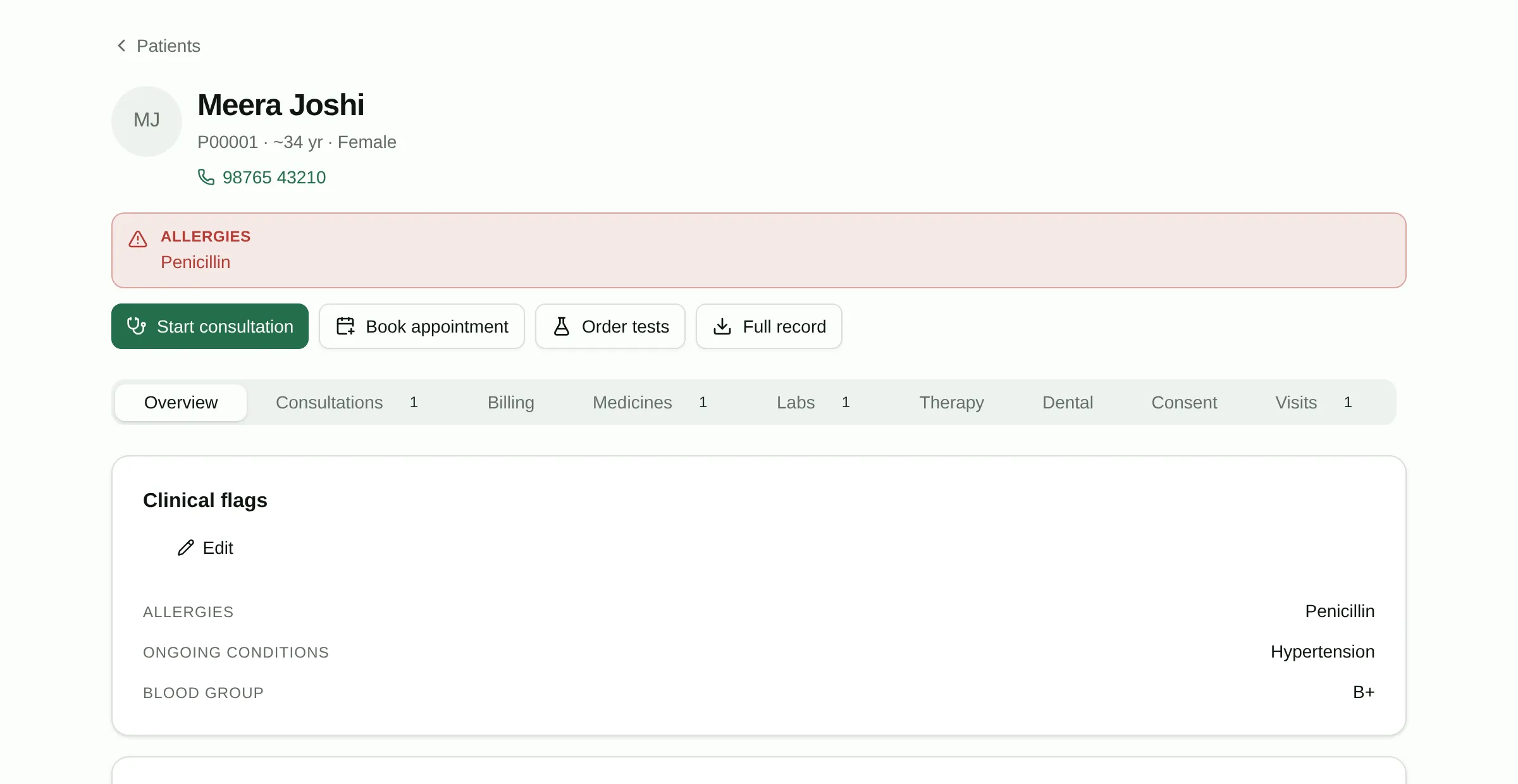
Visits, prescriptions, invoices, dispensed medicine and lab results build one timeline. Six months later the answer to "what did we give her last time?" takes two seconds.
Patient record
One screen each
Most clinic software has one dashboard and shows it to everybody, so a lab technician arrives to four numbers about money. Here the first screen is composed for the job — and each one answers the same three questions: what is happening now, what am I working through, and what is going wrong.
Who is waiting for you. Notes still in draft. Results verified since you last looked. Reviews you advised that nobody has booked.
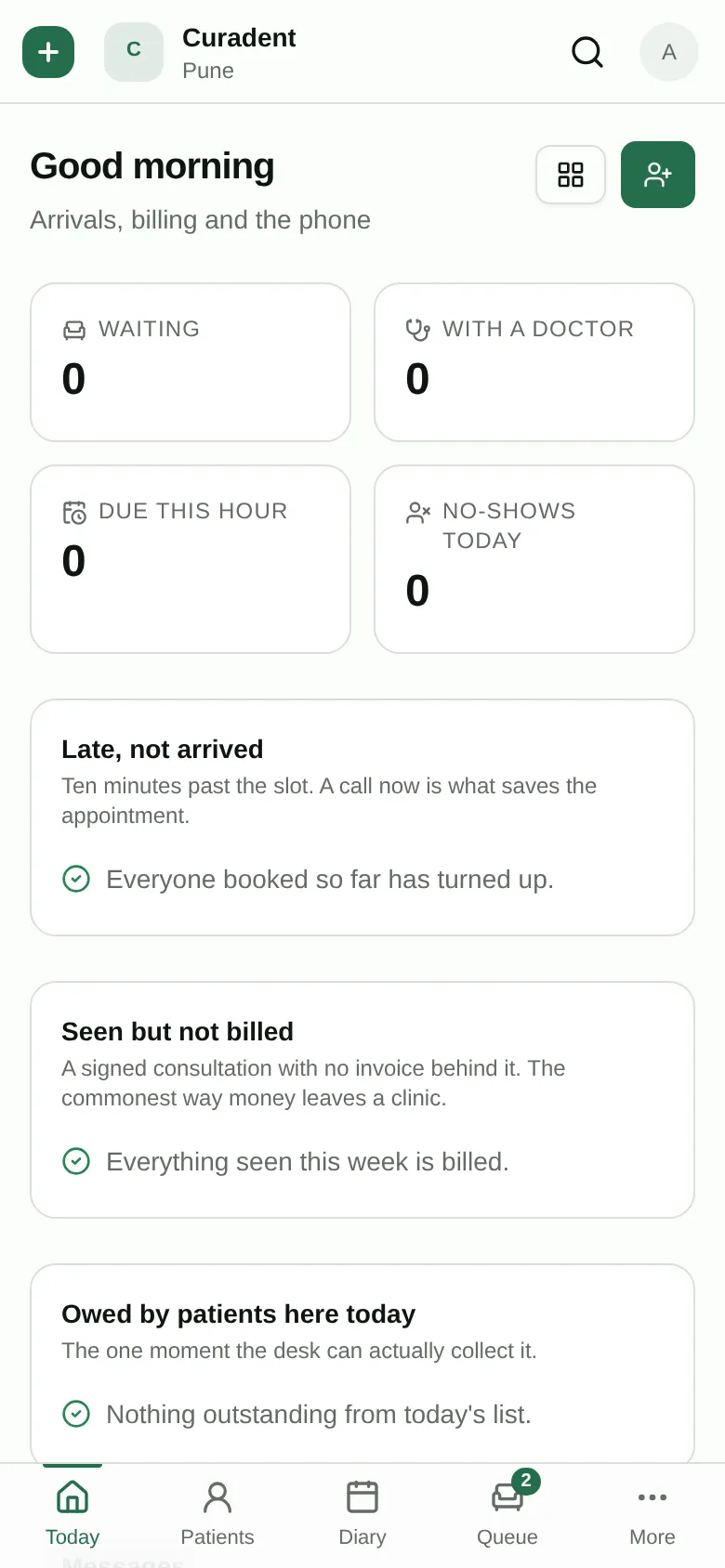
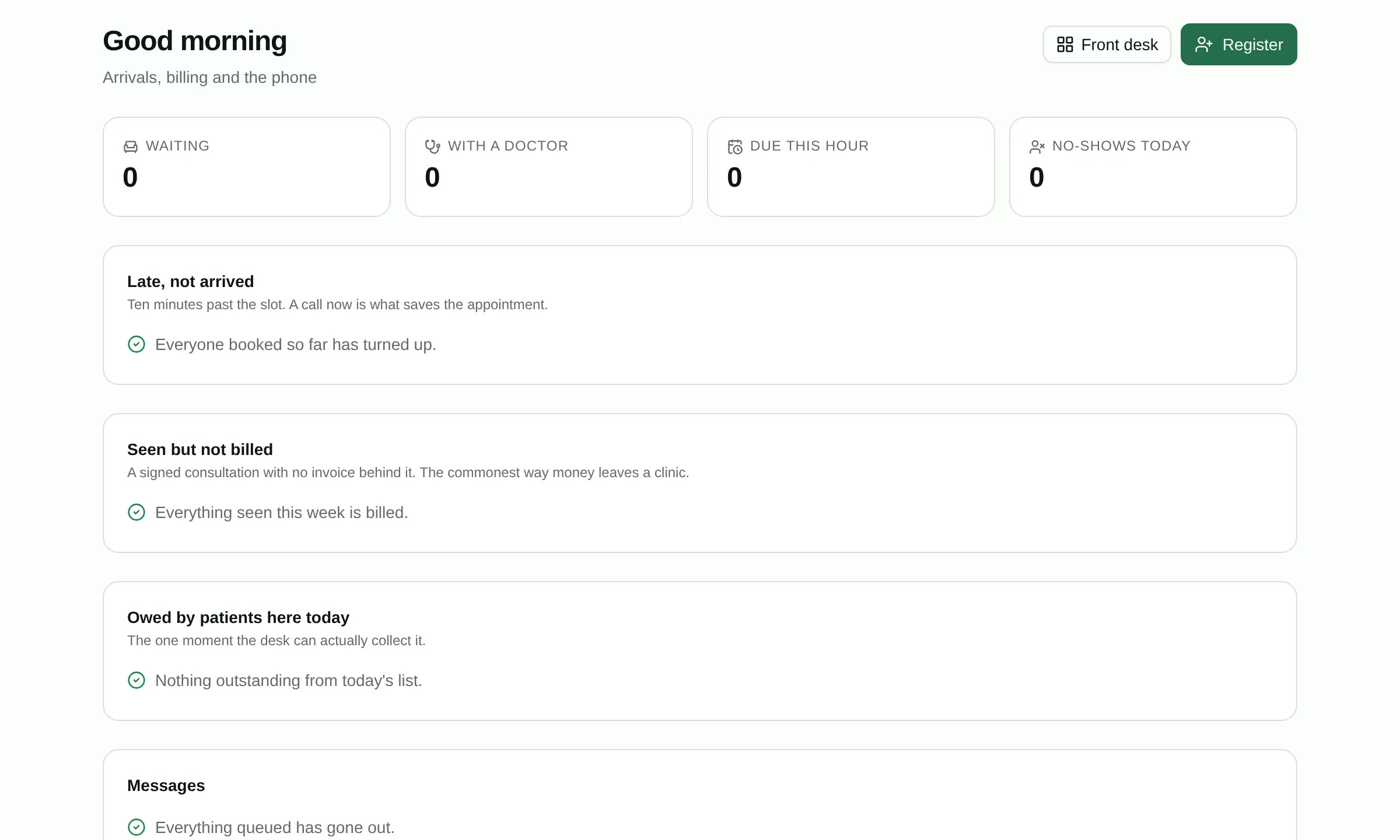
Who is late and needs a call. Consultations finished but never invoiced. What the person standing in front of you already owes.
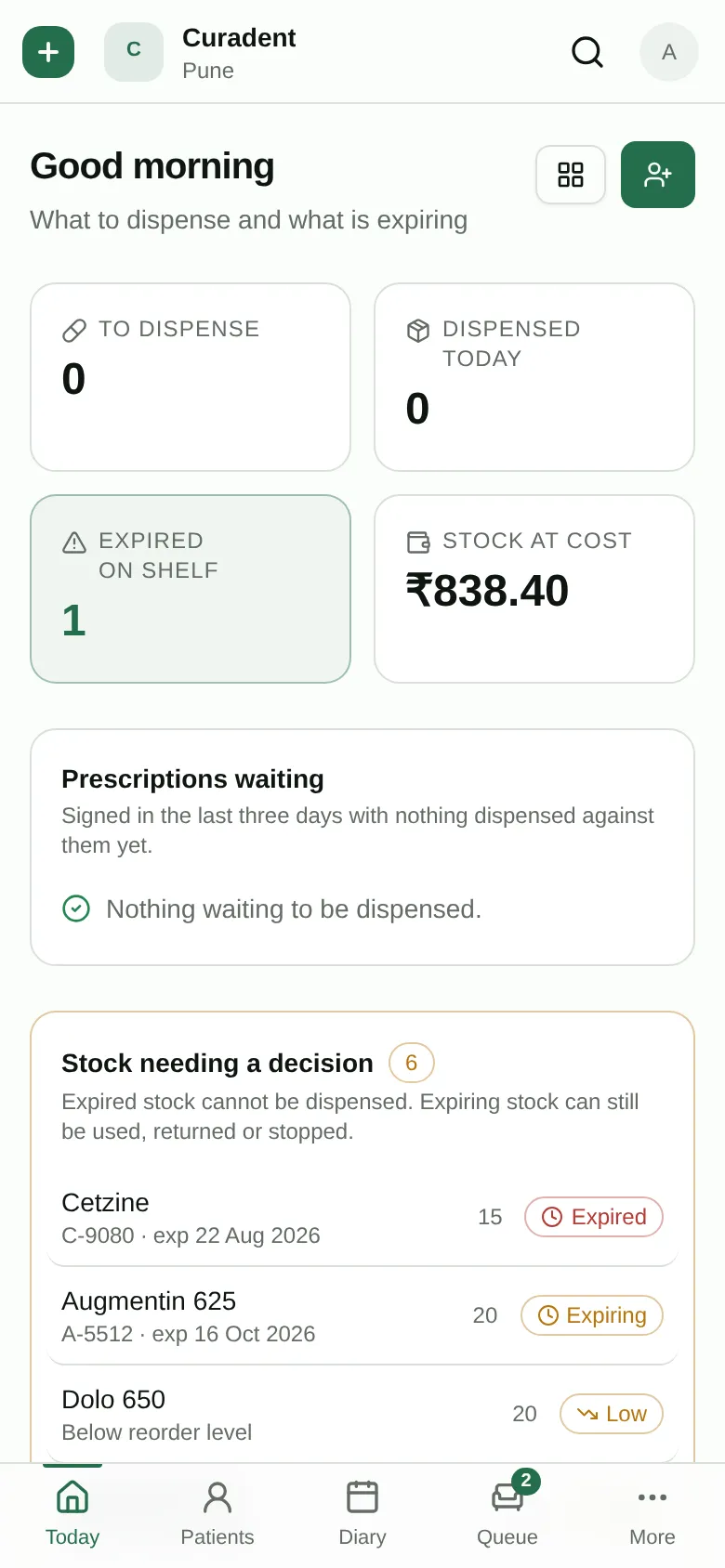
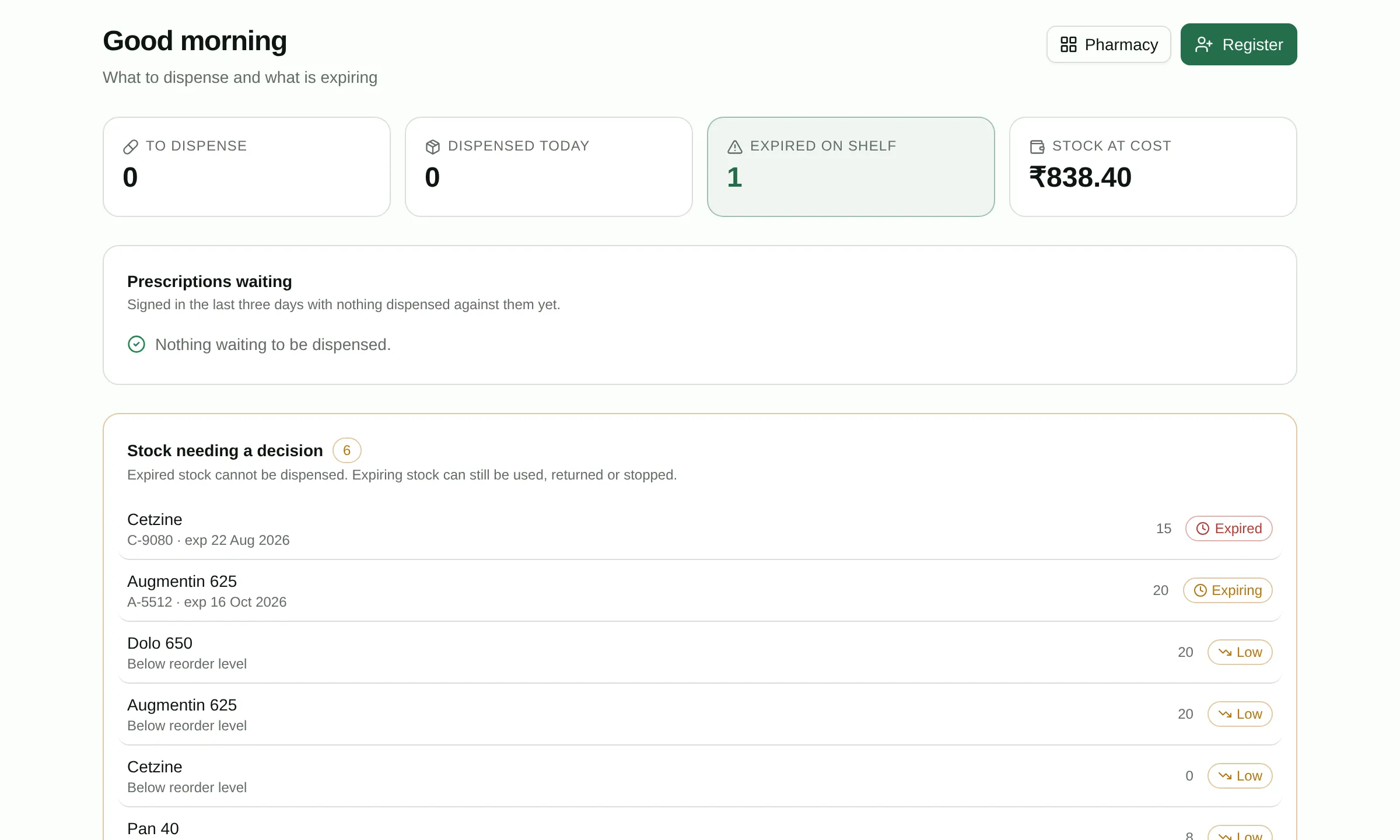
Prescriptions signed and not yet dispensed. Batches expired on the shelf or close to it. Medicine that left the counter with no bill behind it.
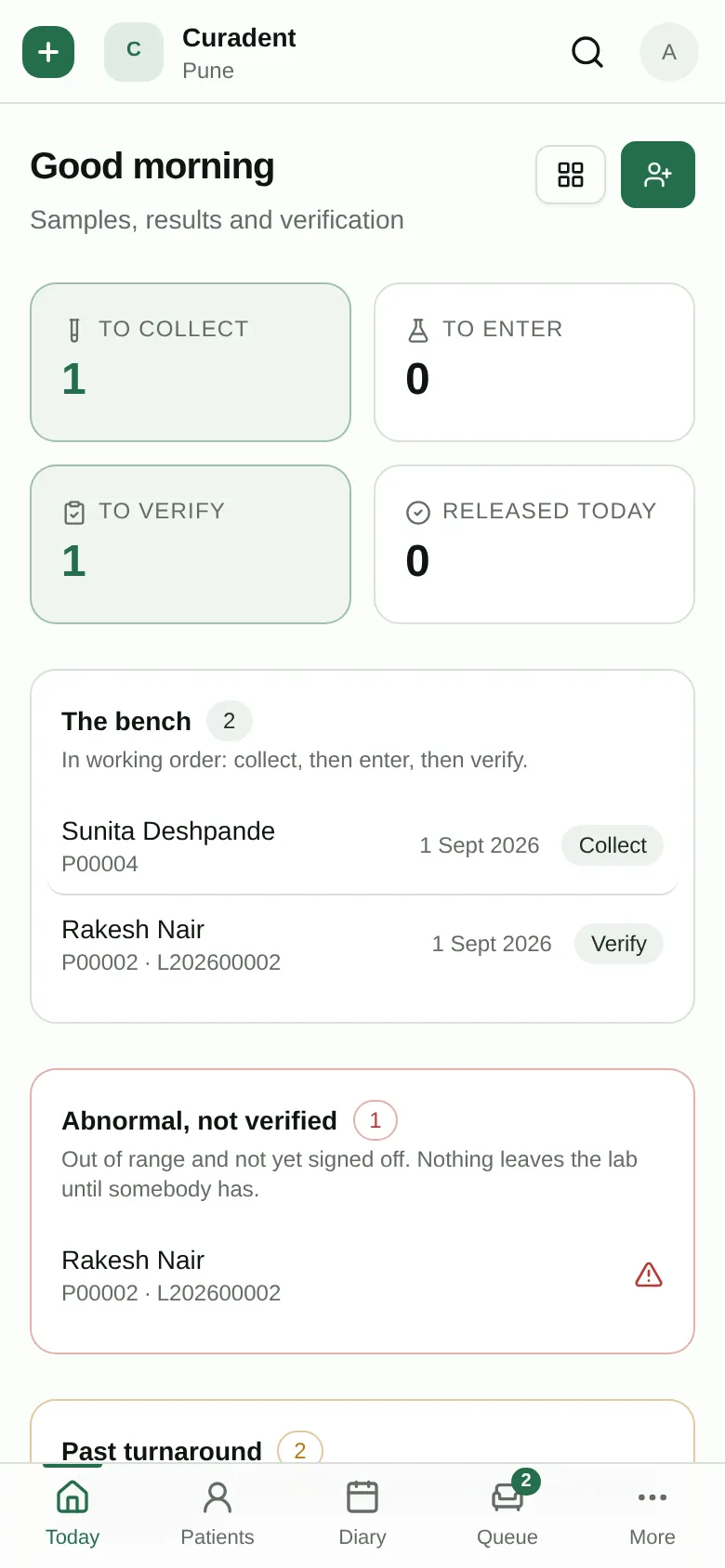
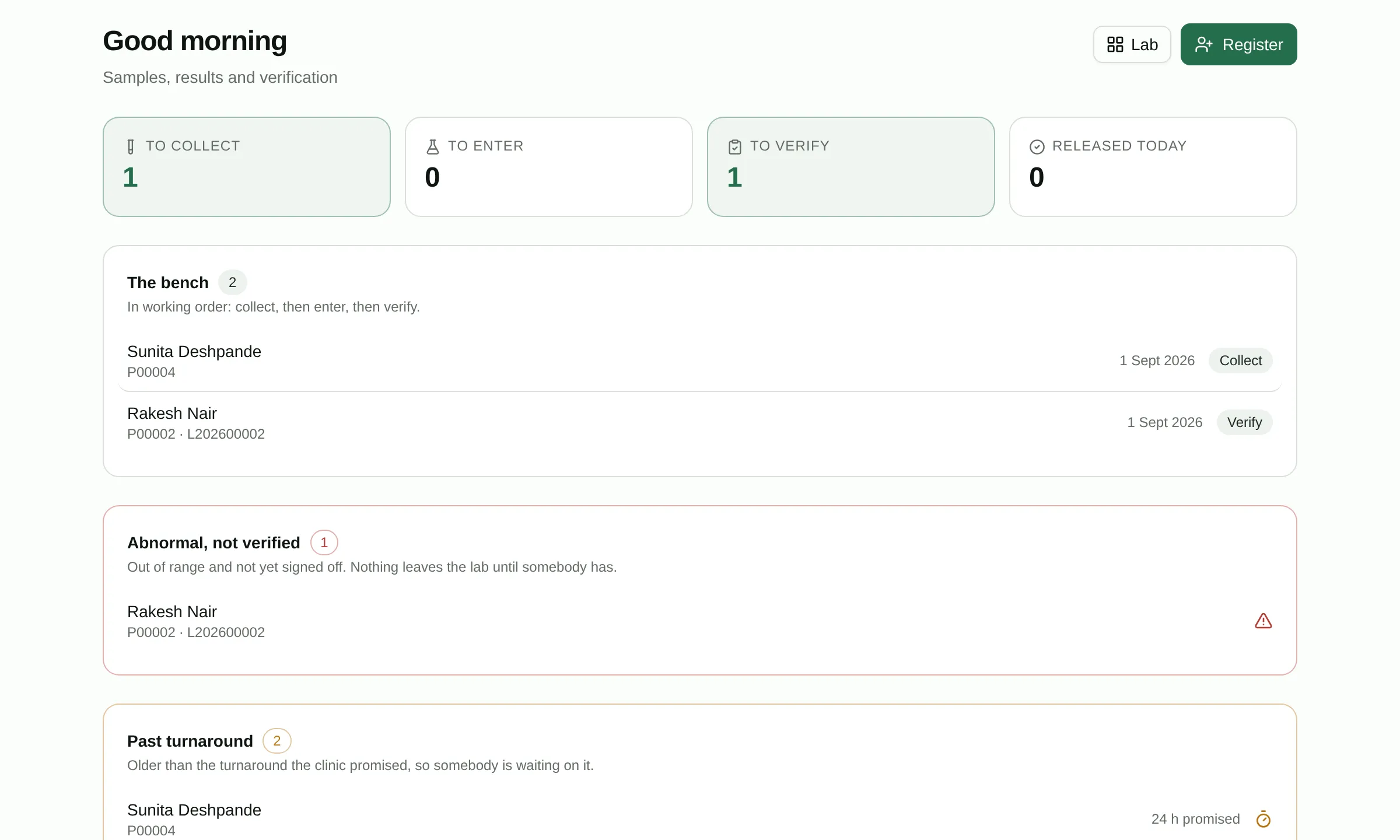
One queue in the order the work is actually done. Abnormal results nobody has signed off sit on their own, because those are the ones that hurt.
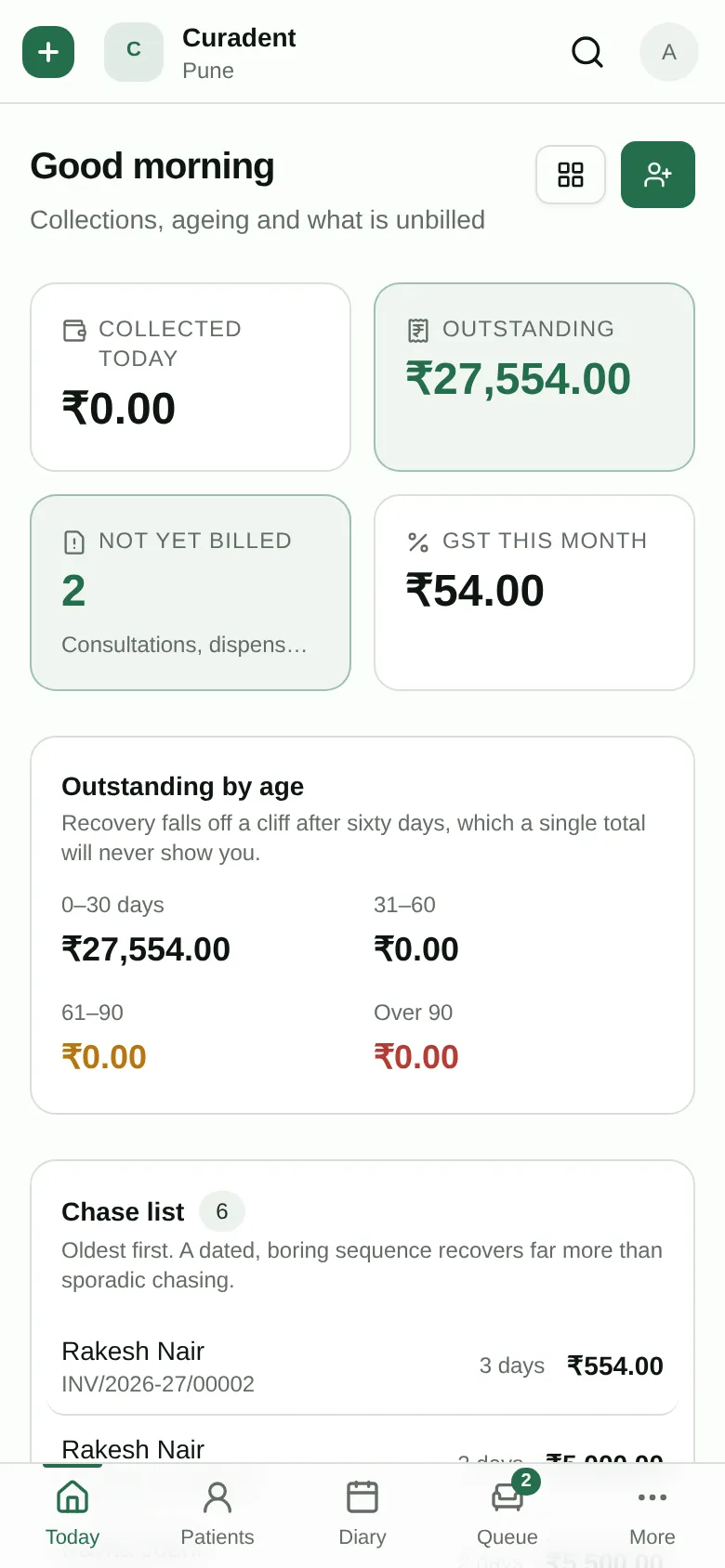
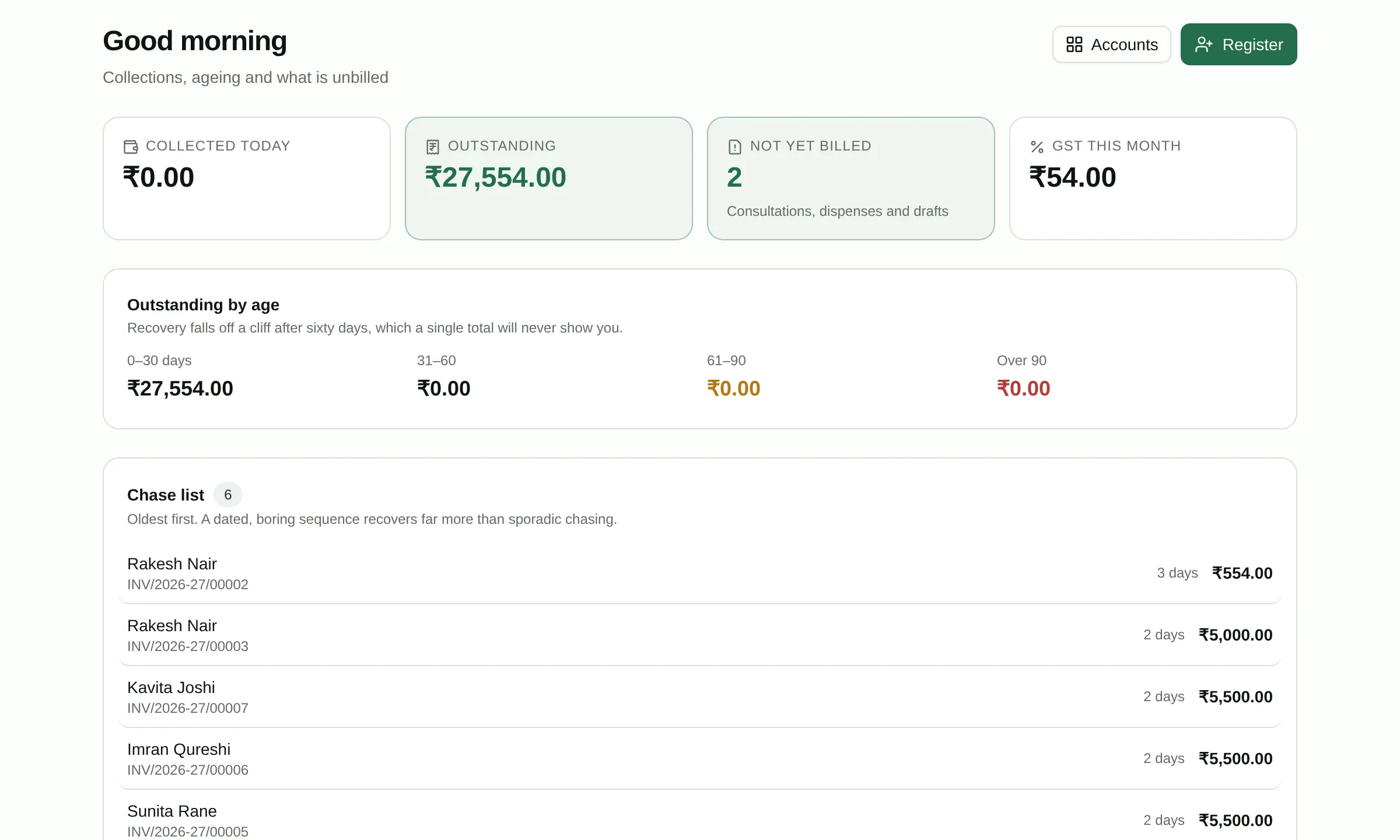
Outstanding split by age, because recovery falls off a cliff after sixty days and a single figure hides it. Plus everything still waiting to be billed.
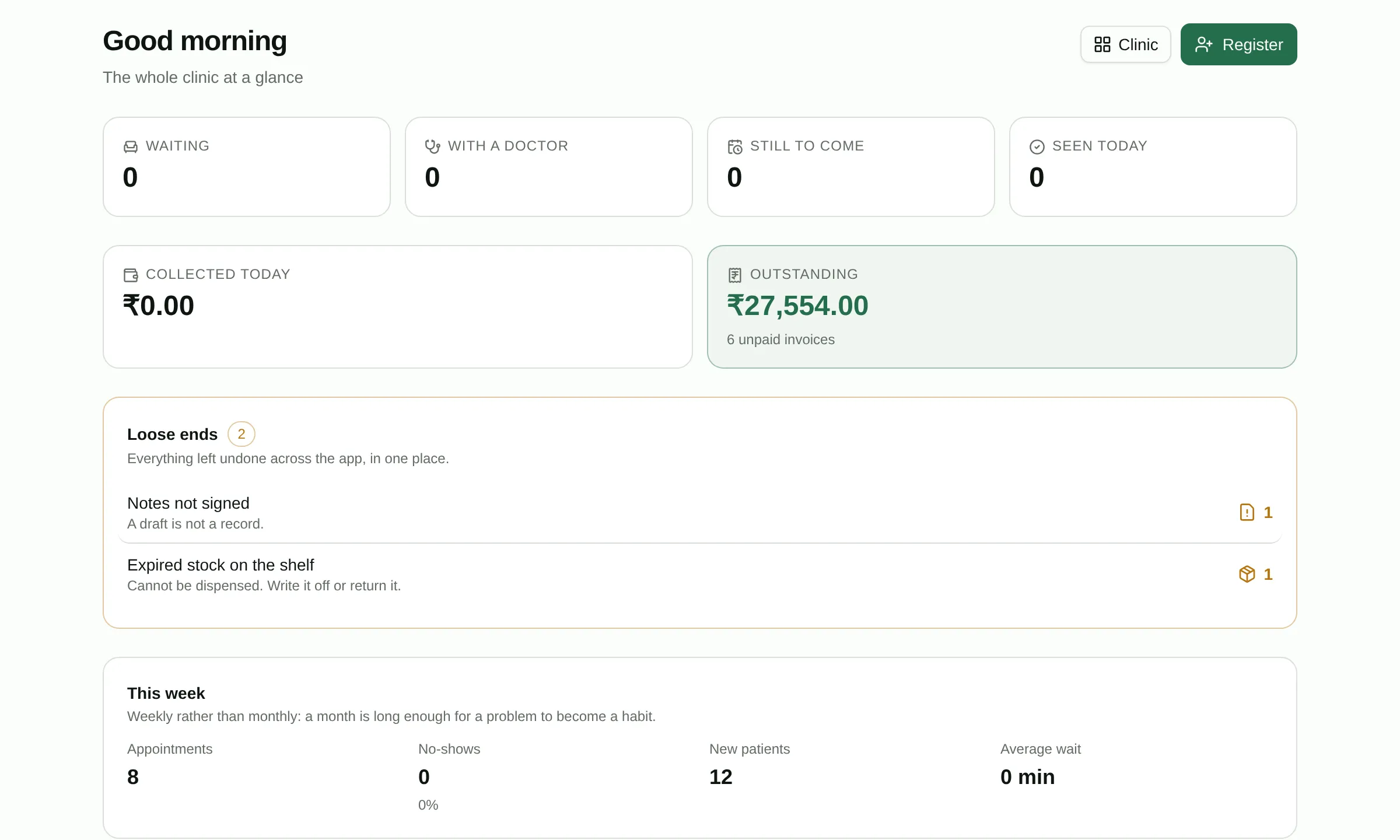
Today’s numbers, the week’s trend, and everything left undone anywhere in the app — because you are the only person who sees all of it.
The base clinic
Not six products bolted together. A prescription becomes a dispense becomes a stock movement becomes a line on the invoice, because it is all one database.
This is the base clinic, and it is on every plan. Pharmacy and labs follow the plan you pick. On top of it you choose one speciality module.
Book by doctor and room, see the whole day at a glance, and let the database refuse double-booked slots rather than trusting everyone to notice.
Invoices are numbered without gaps, totalled by the server, and frozen once issued. Part payments, refunds and outstanding balances all track back to the patient.
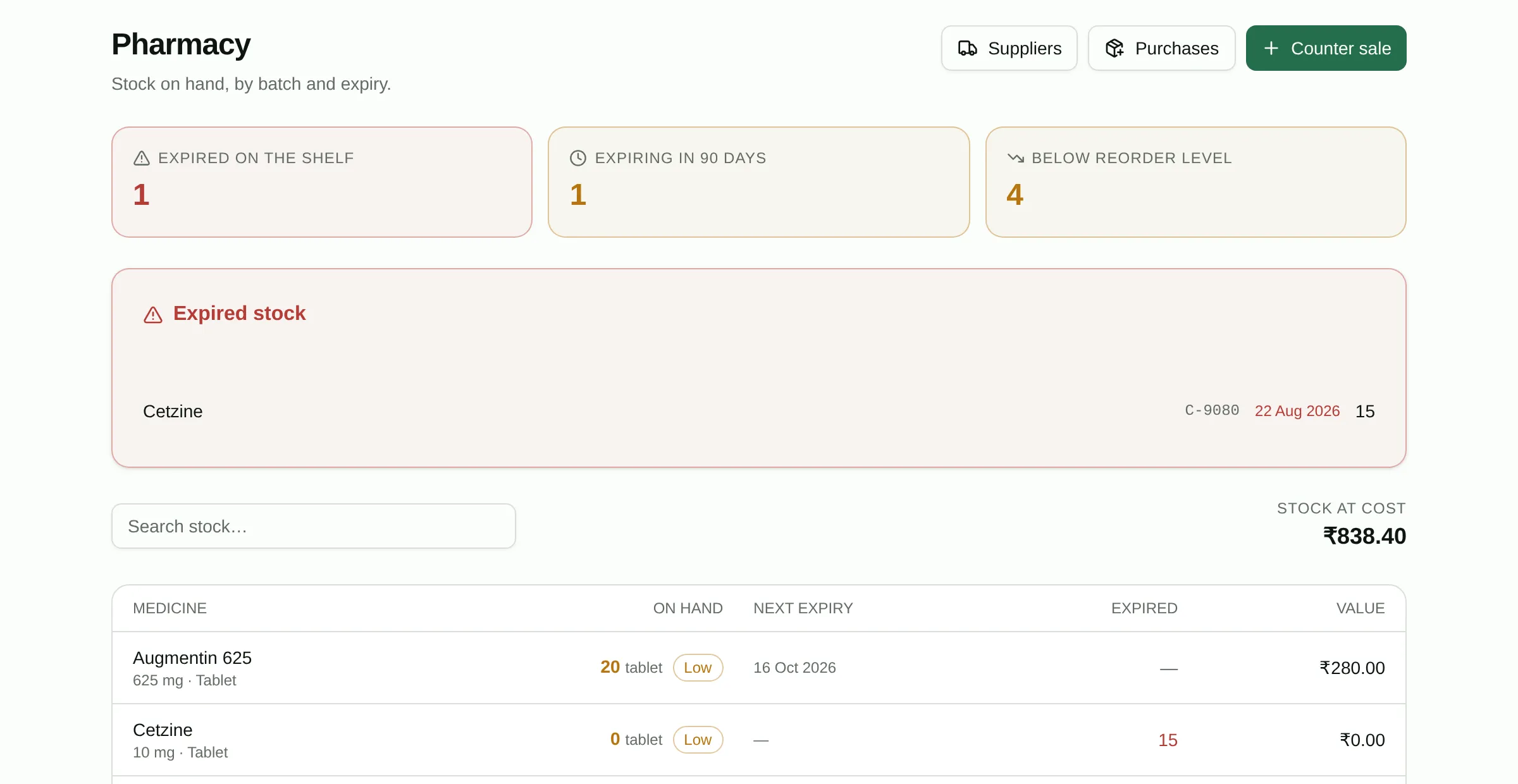
Stock by batch and expiry, dispensed first-expiry-first-out. Quantity is derived from an append-only ledger, so it can be audited rather than merely believed.
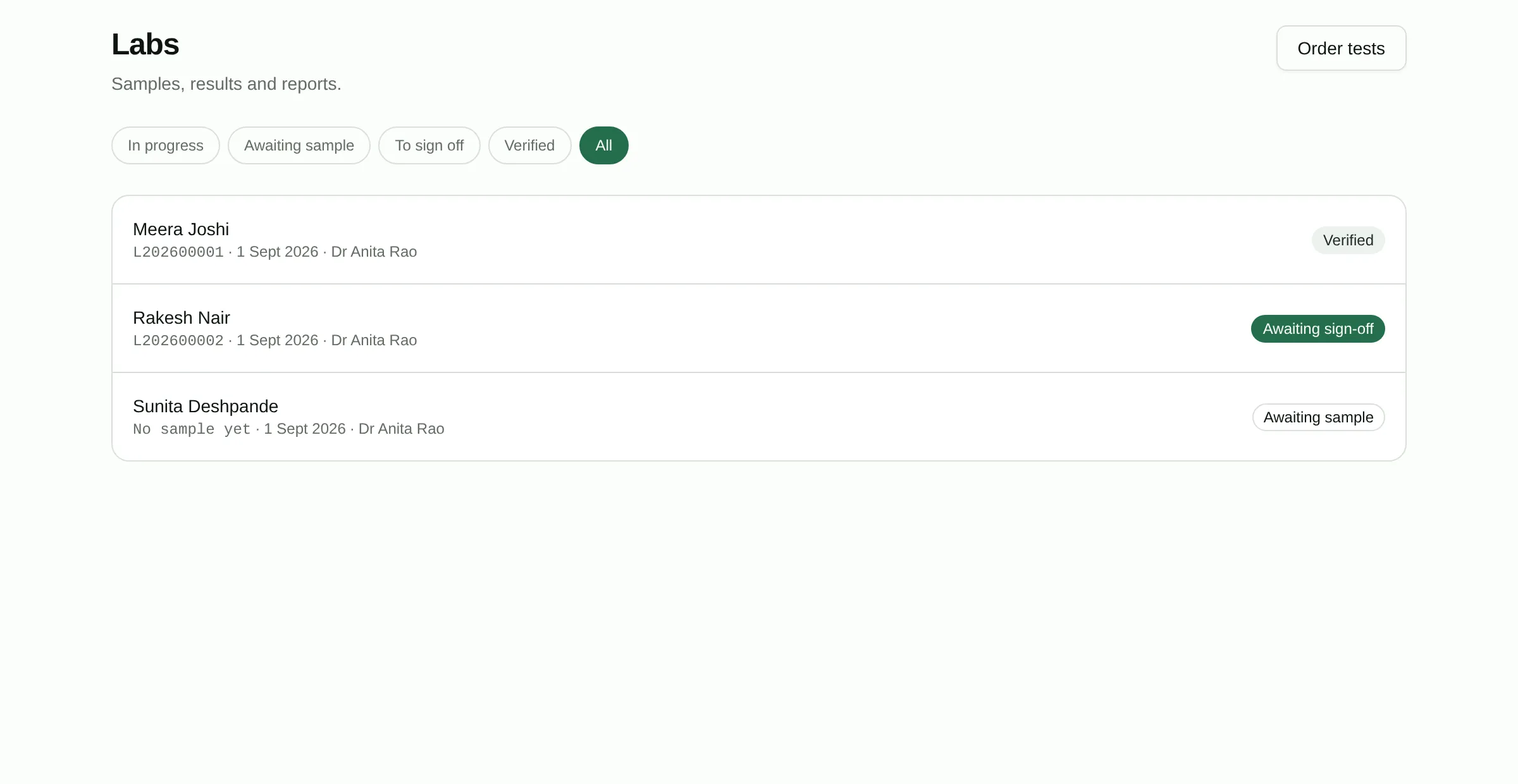
Panels with reference ranges by age and sex, out-of-range values flagged on entry, and a report that only leaves the building once someone has verified it.
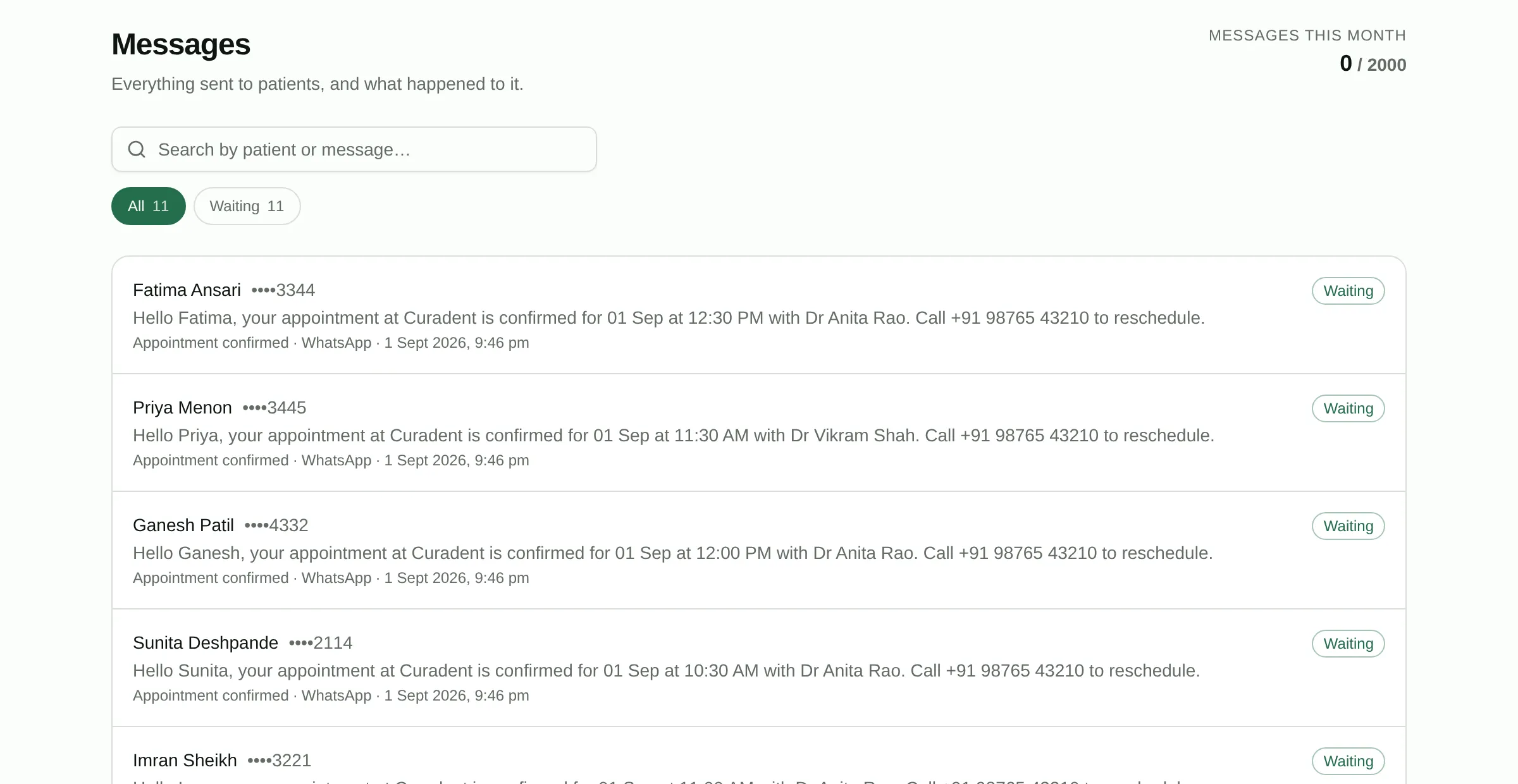
Appointment reminders and report-ready notices on WhatsApp, SMS or email — in an order you choose, falling back to the next when one fails. Opt-outs are honoured before a message is ever rendered.
Reports
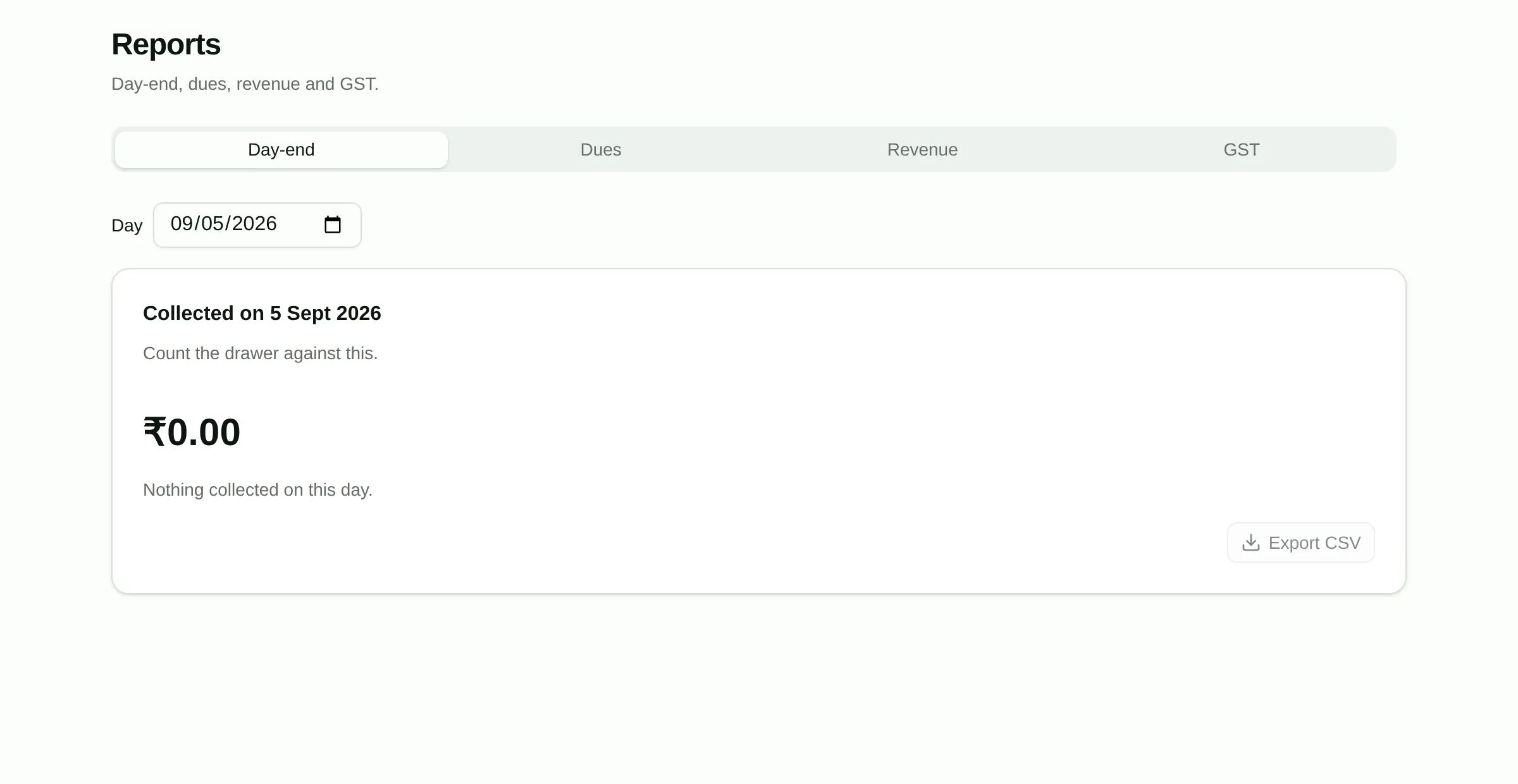
Collections by day, by doctor and by payment mode. Stock value and expiring batches. Patients seen, and who has not come back — not a nightly export you have to remember to run.
One module, chosen once
Software that tries to be a paediatric practice, a physio clinic and a dental surgery at once ends up asking every clinic to ignore two-thirds of its own screens. So the base clinic is the same for everybody, and one speciality module goes on top of it.
Nothing here is an upgrade or an add-on. It is what a clinic is.
Pharmacy stock and labs follow the plan you choose — see pricing.
Immunisation schedules with real catch-up dates, the due list somebody rings, batch traceability on every dose, WHO growth charts, and the card a parent keeps.
See itSession packages rather than visits, episodes of care, standardised outcome measures with their thresholds, and the money you have collected but not yet delivered.
See itA tooth chart you can read as it stood on any past date, quotations the patient accepts or declines, work billed when it finishes rather than per sitting, periodontal charting, and the crown that is late back from the laboratory.
See itRefraction and IOP stored per eye so the trend is readable, surgery follow-up schedules, and the optical counter.
Panchakarma courses with therapist and room booking, and stock that understands loose material and in-house preparations.
The base clinic and nothing speciality-specific on top. The right answer for most single-doctor practices.
A speciality changes the shape of the record itself — an immunisation course, a session package, a tooth chart. Switching mid-way would leave half a record in one shape and half in another, and the half you could no longer read would be the clinical half. So a clinic picks once, and the app asks twice before it sets it.
Nothing about it is required to run the clinic. If the module you want is not ready yet, leave it — the base clinic works completely on its own, and you can choose when the one you need exists. And if it is ever set in error, write to us and we will reset it. Permanent means you cannot change it on a whim, not that nobody can fix a mistake.
Speciality module · available now
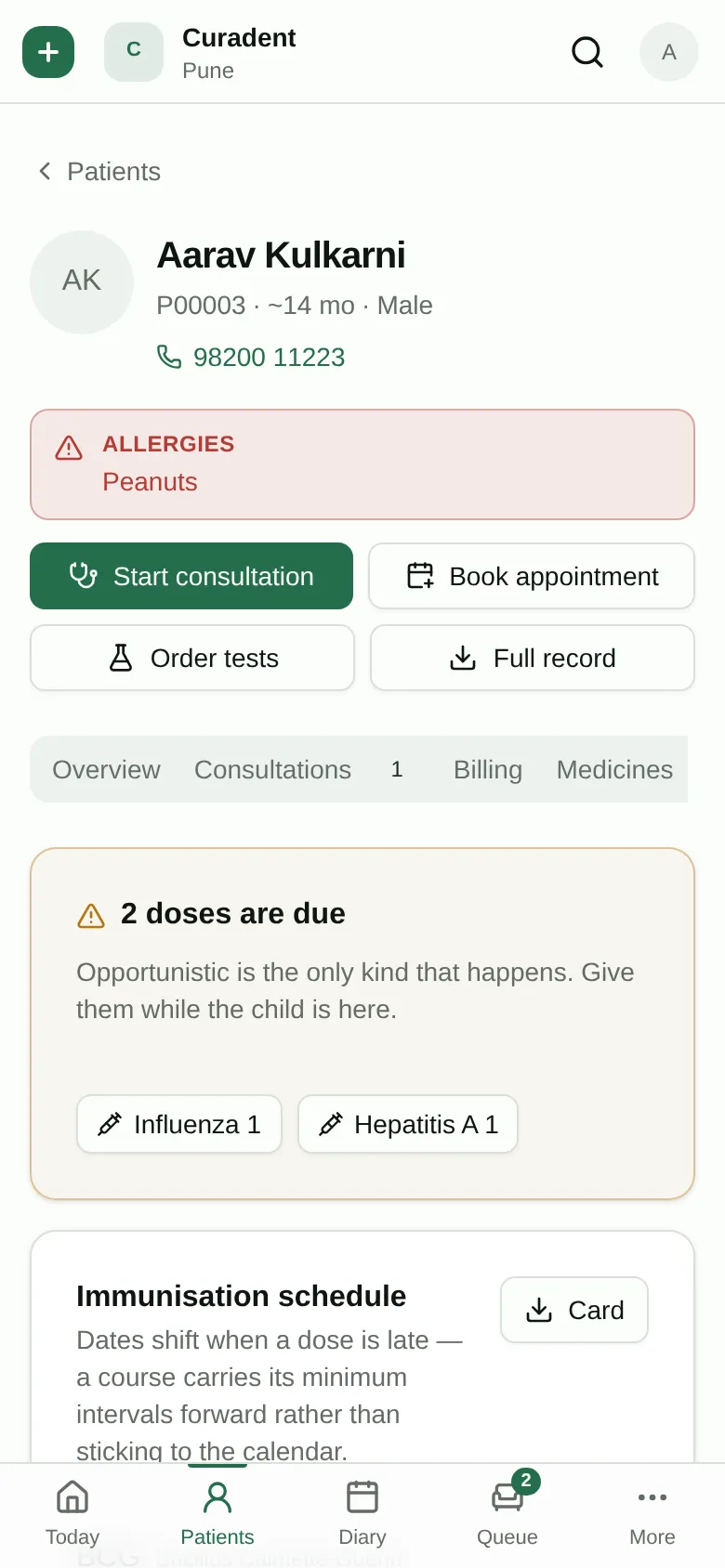
Most clinic software treats vaccination as a note in the record. A paediatric practice needs it to be a schedule that knows the child’s date of birth, shifts when a dose is late, and produces the list of parents to ring on Monday.
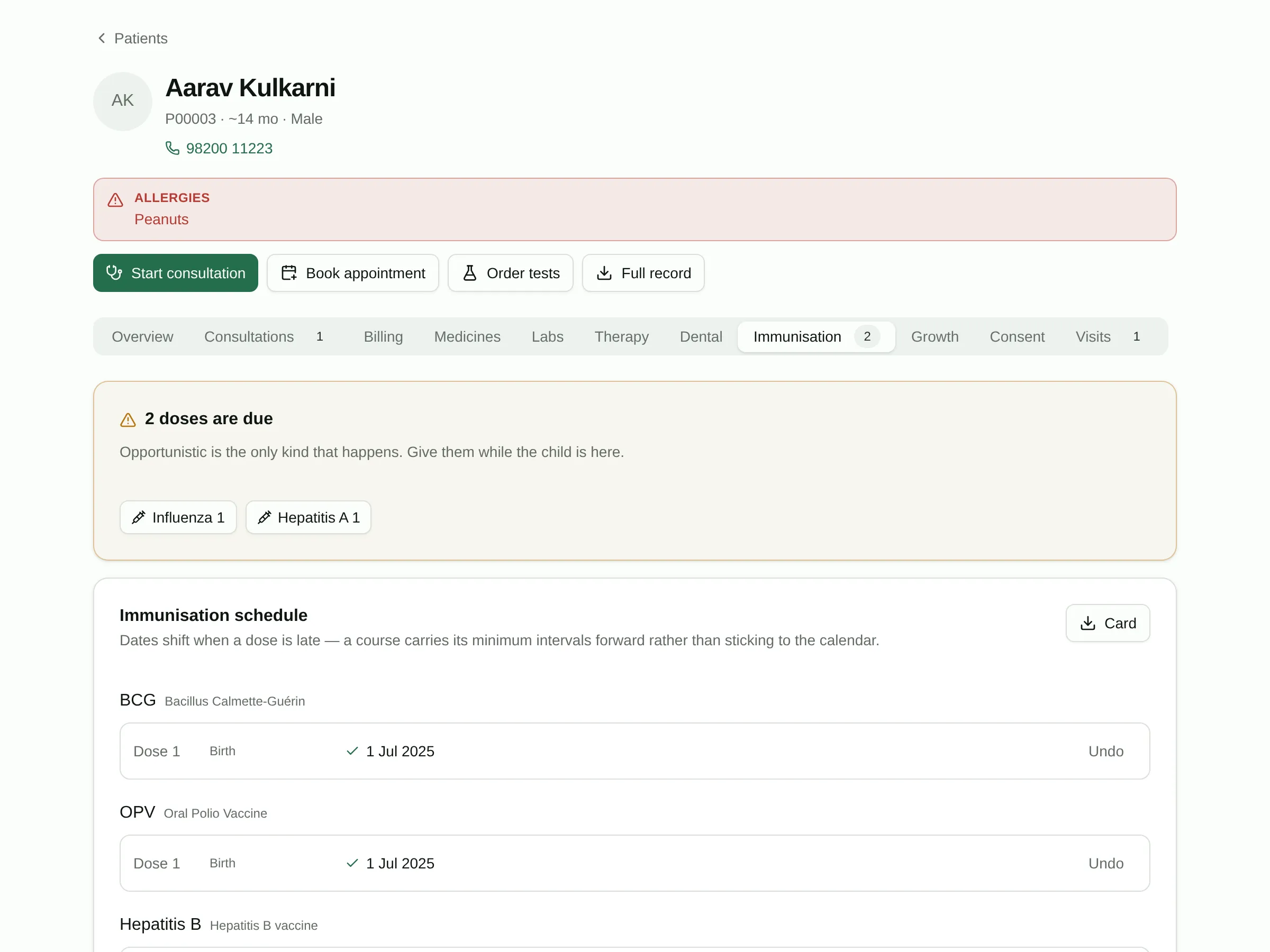
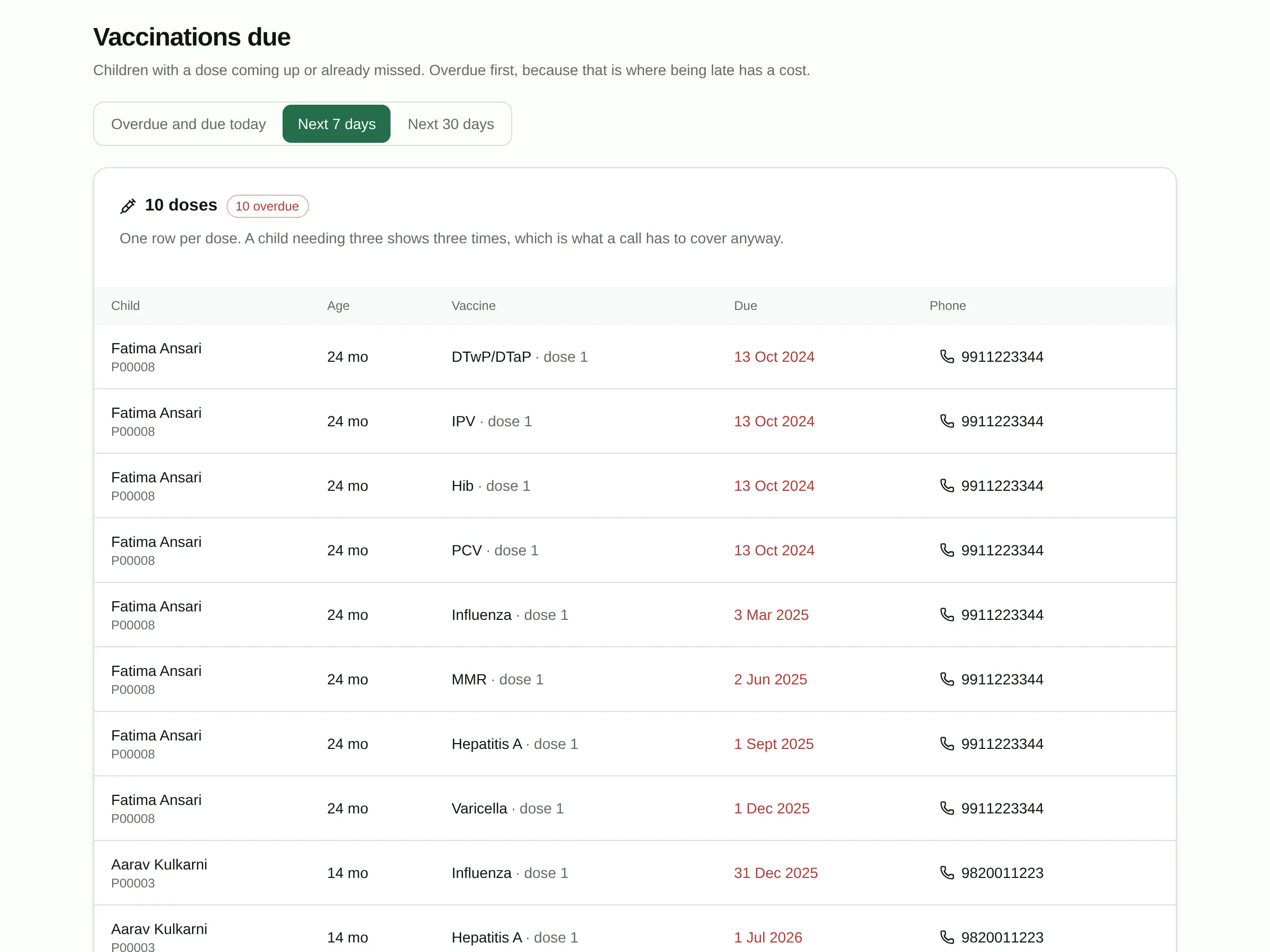
The IAP-ACVIP 2025 recommendations and the government Universal Immunization Programme schedule, both transcribed from the published sources and both selectable. Copy either and edit it — the schedule is data, not something we decide for you.
A dose given six weeks late does not simply move; every later dose in that course shifts by its minimum interval. The dates you see are recomputed from what actually happened, not read off a wall chart.
Every dose records the batch, expiry and site, drawn from your own stock. When a batch is recalled the question is which children received it, and that has to be answerable in seconds rather than by going through a register.
Overdue and due this week, across the whole clinic, with the parent’s number beside each name. A reminder goes out a few days before — once per dose, never repeated.
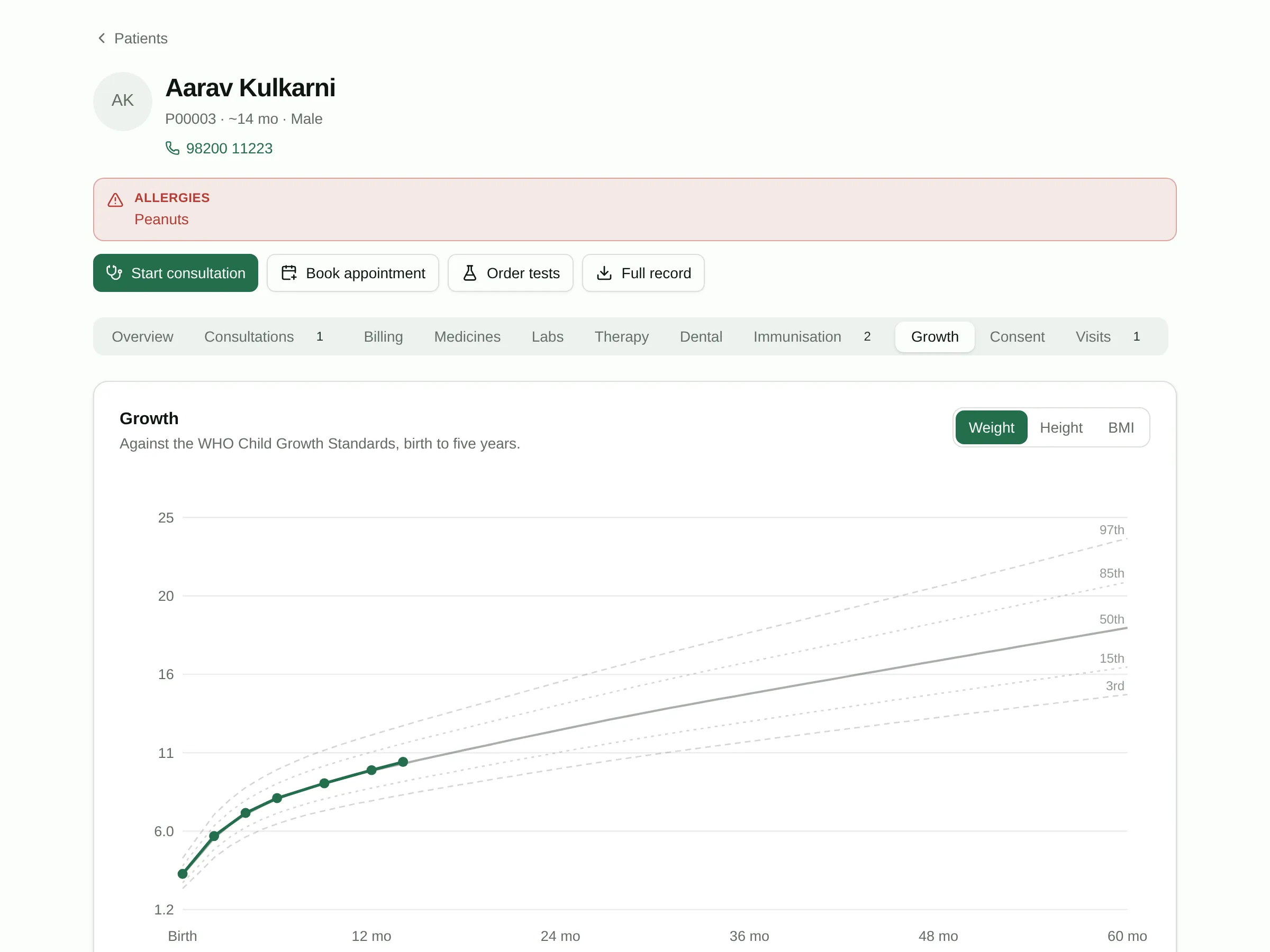
Weight, height and BMI plotted on the WHO Child Growth Standards for the child’s sex, with the exact percentile and z-score. Computed from the LMS coefficients, so the number is right in the tails where it matters.
An immunisation card on your letterhead, printed fresh each time so the dates on it are the ones that apply today. Schools will ask for it for years.
On a phone
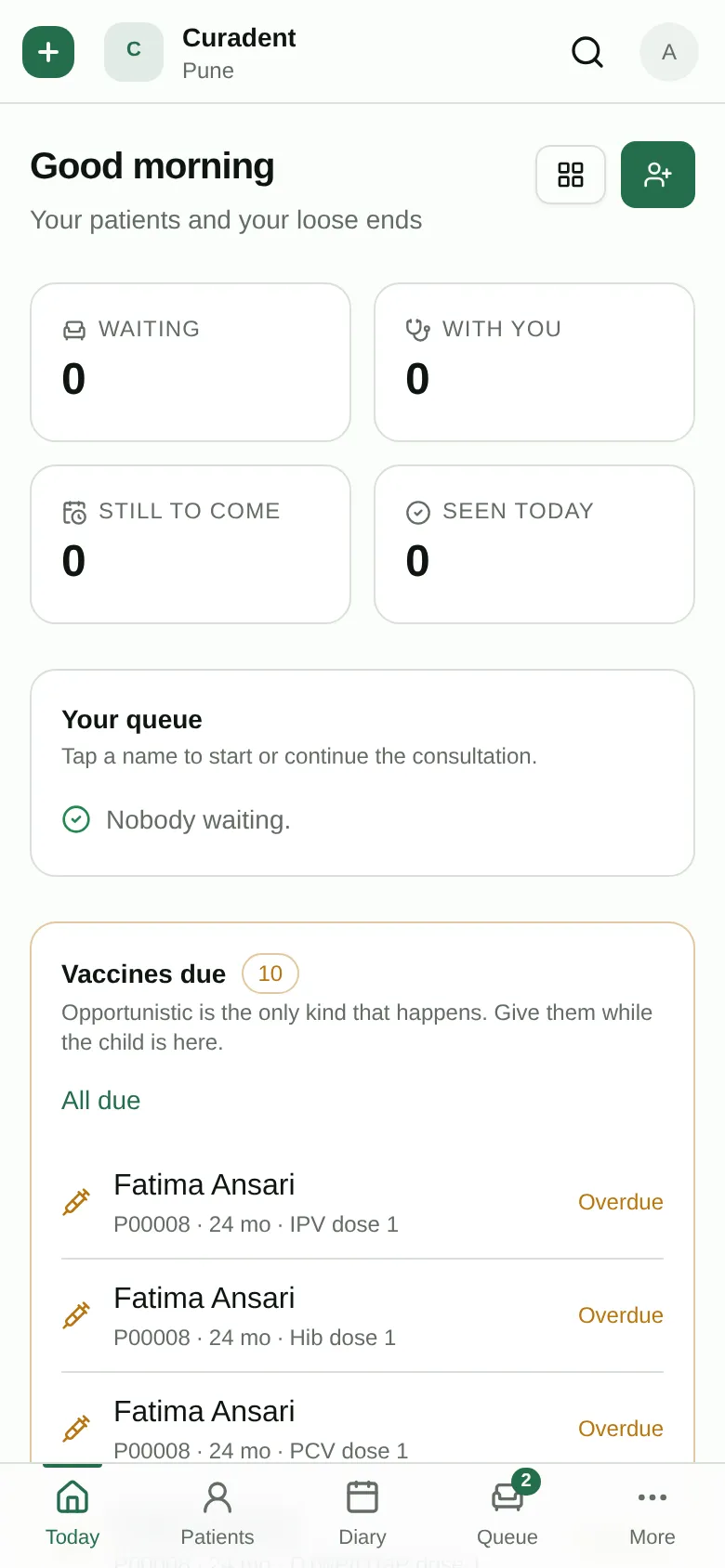
A paediatric OPD in fever season runs at six minutes a child. Whatever is due has to be on the screen already, not two taps away — because opportunistic is the only kind of vaccination that reliably happens.
And it is the whole clinic, not a paediatric product: appointments, GST billing, pharmacy stock and labs are the same ones every other practice gets.
The schedules are transcribed from theIAP-ACVIP 2025 recommendationsand theNational Immunization Schedule, and growth uses theWHO Child Growth Standards. They are a starting point rather than medical advice: the clinic owns what it follows, and a schedule changes.
Speciality module · available now
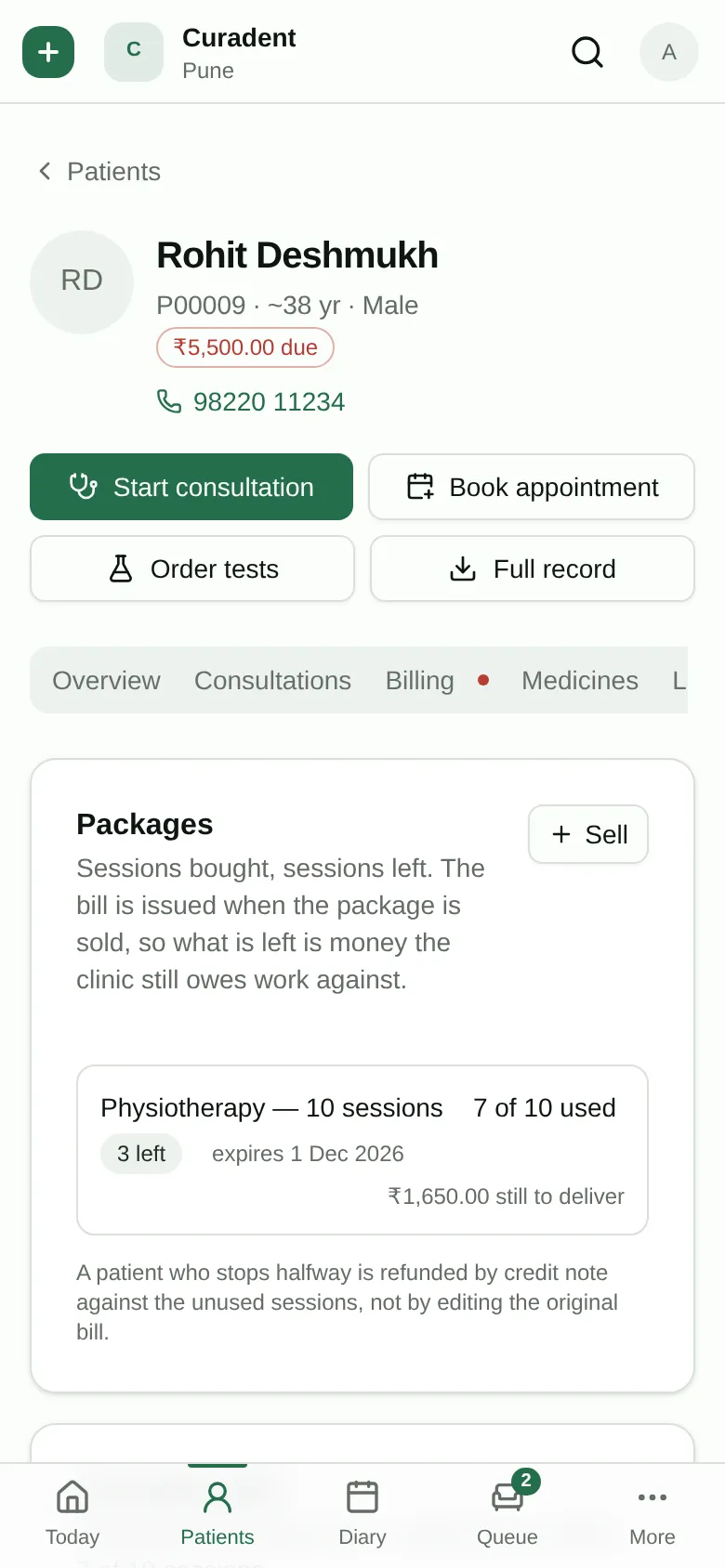
Ten sessions, quoted up front, paid up front, delivered over six weeks. Software that models each session as its own invoice fights a physio clinic every day, because the money and the treatment are on different schedules.
This is the speciality module a physiotherapy practice chooses, on every plan, on top of the base clinic.
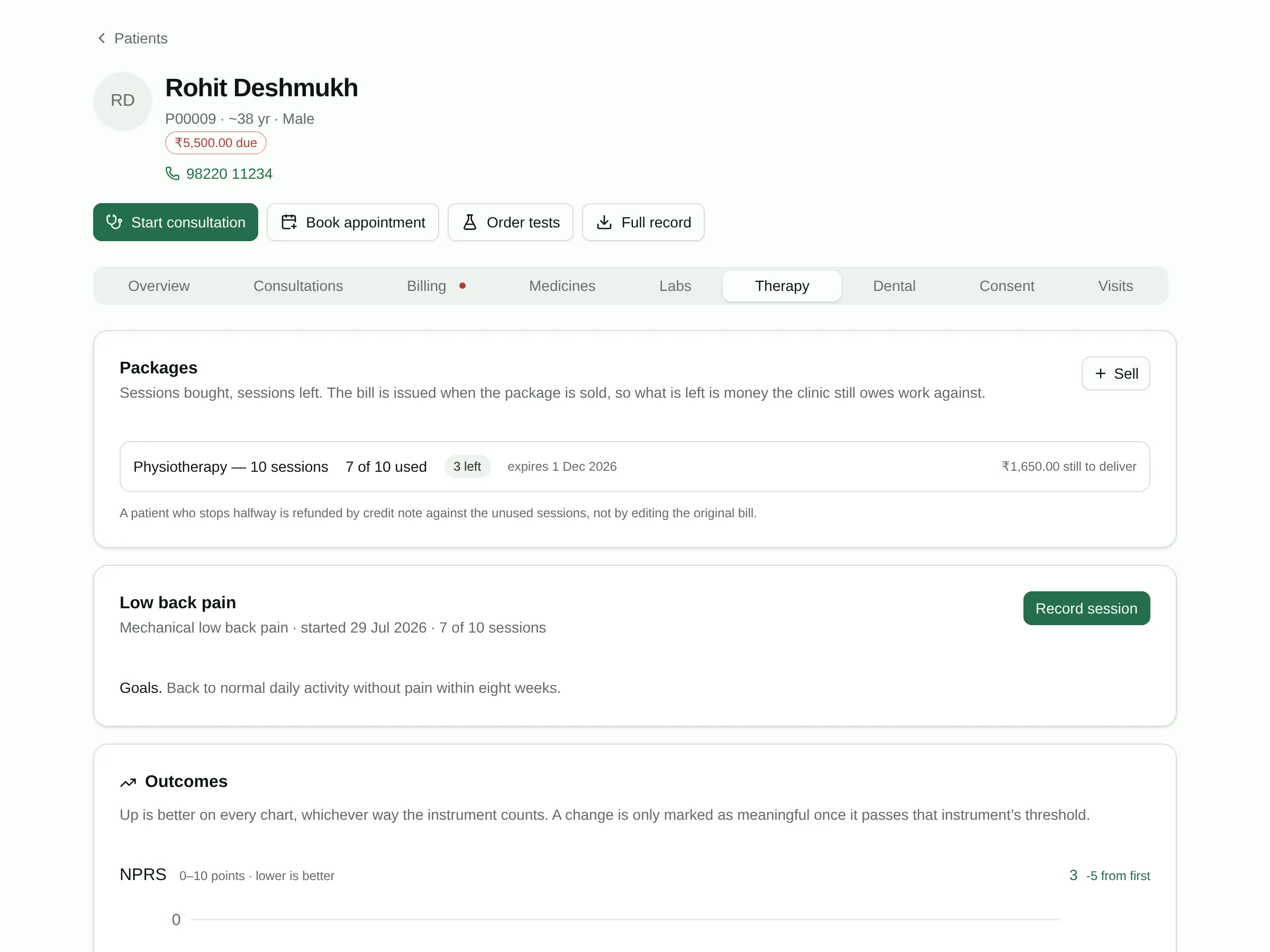
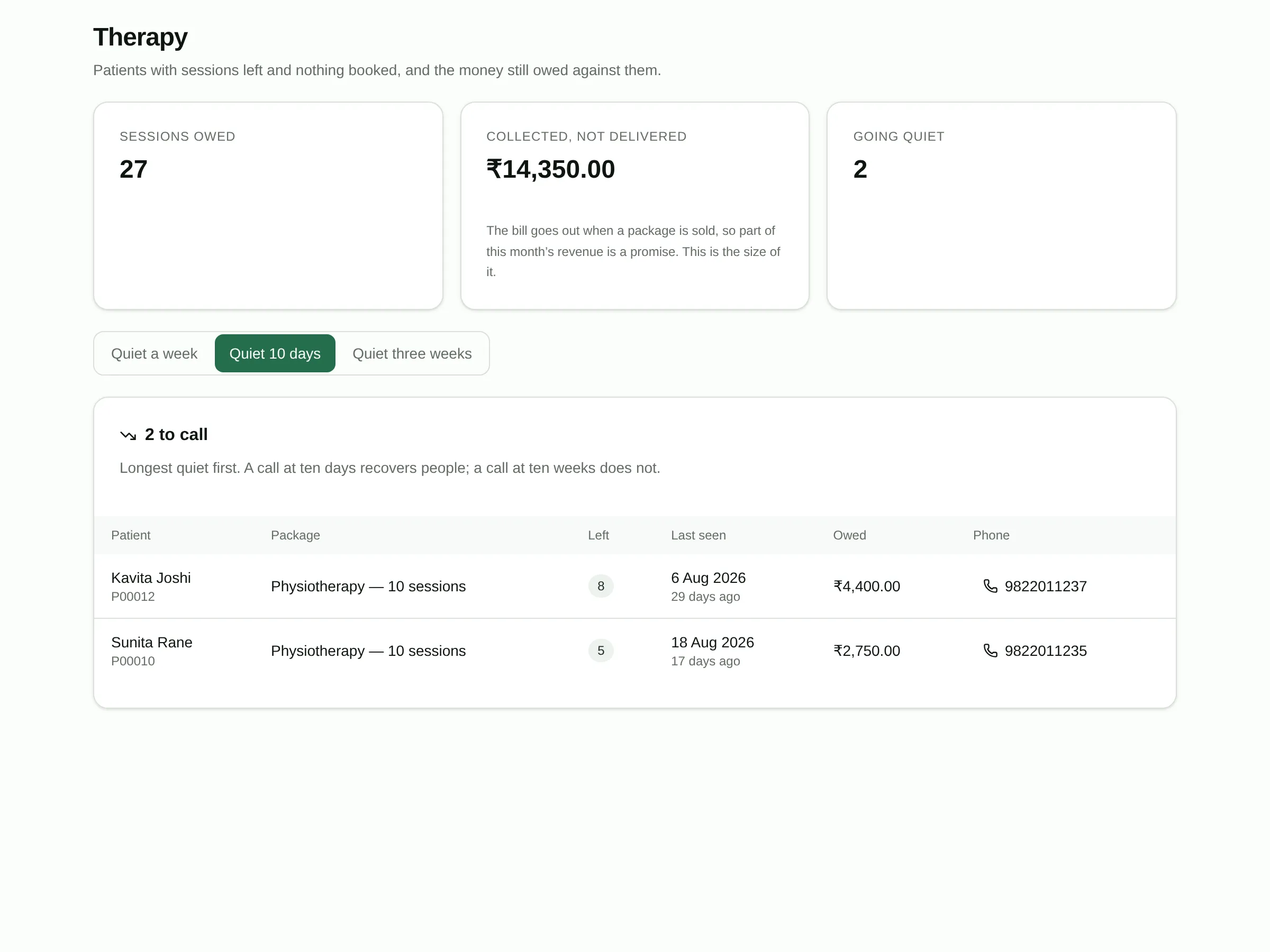
A ten-session course quoted and paid up front, drawn down one appointment at a time. Sessions remaining sit at the front desk, so "how many do I have left" is a two-second answer rather than a hunt through a register.
The bill goes out when the package is sold, which means part of a good month is a promise. The clinic sees exactly how many sessions it still owes and what was collected against them — a number almost no practice has.
A course of treatment with a diagnosis, goals, planned sessions and a review date. Sessions, packages and outcome scores all hang off it, so a discharge summary writes itself.
NPRS, Oswestry, Neck Disability Index, QuickDASH, LEFS, WOMAC, Berg and Timed Up and Go, each with its published range and threshold. A change is only marked meaningful once it passes that instrument’s minimal clinically important difference.
Four short fields per session rather than one long one, and signing freezes the note. A correction afterwards is a new dated entry, never a quiet edit of the old one.
A physiotherapy clinic runs out of treatment tables before it runs out of therapists. Tables, the gym floor and the traction unit are bookable, and the database refuses to double-book them.
The number nobody has
It is bad clinically and it leaves the clinic holding money for work it has not done. Anyone with sessions left and nothing in the diary is on one list, longest quiet first, with the phone number beside the name.
And it is the whole clinic underneath: appointments, GST billing, patient messaging and reports are the same ones every other practice gets.
The outcome instruments are published scales with published scoring and thresholds, entered from their source references. They are a starting point for a clinician rather than medical advice, and the thresholds differ between studies and populations — check them against your own practice before relying on them.
Speciality module · available now
Often to one surface of one tooth. Software whose smallest unit is the visit makes a dentist write the mouth down in prose, and then makes them read it back that way at the next appointment.
This is the speciality module a dental practice chooses, on every plan, on top of the base clinic.
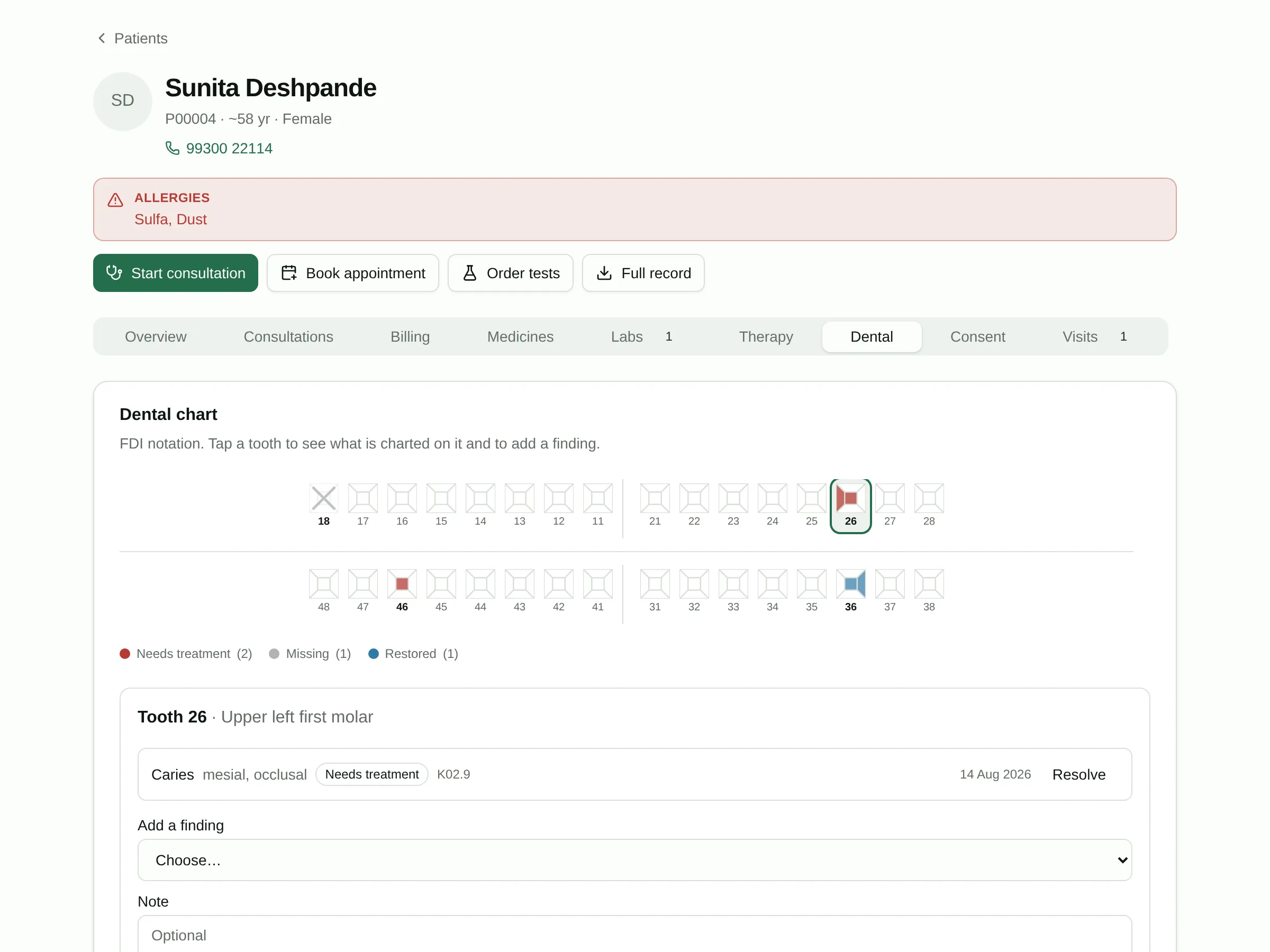
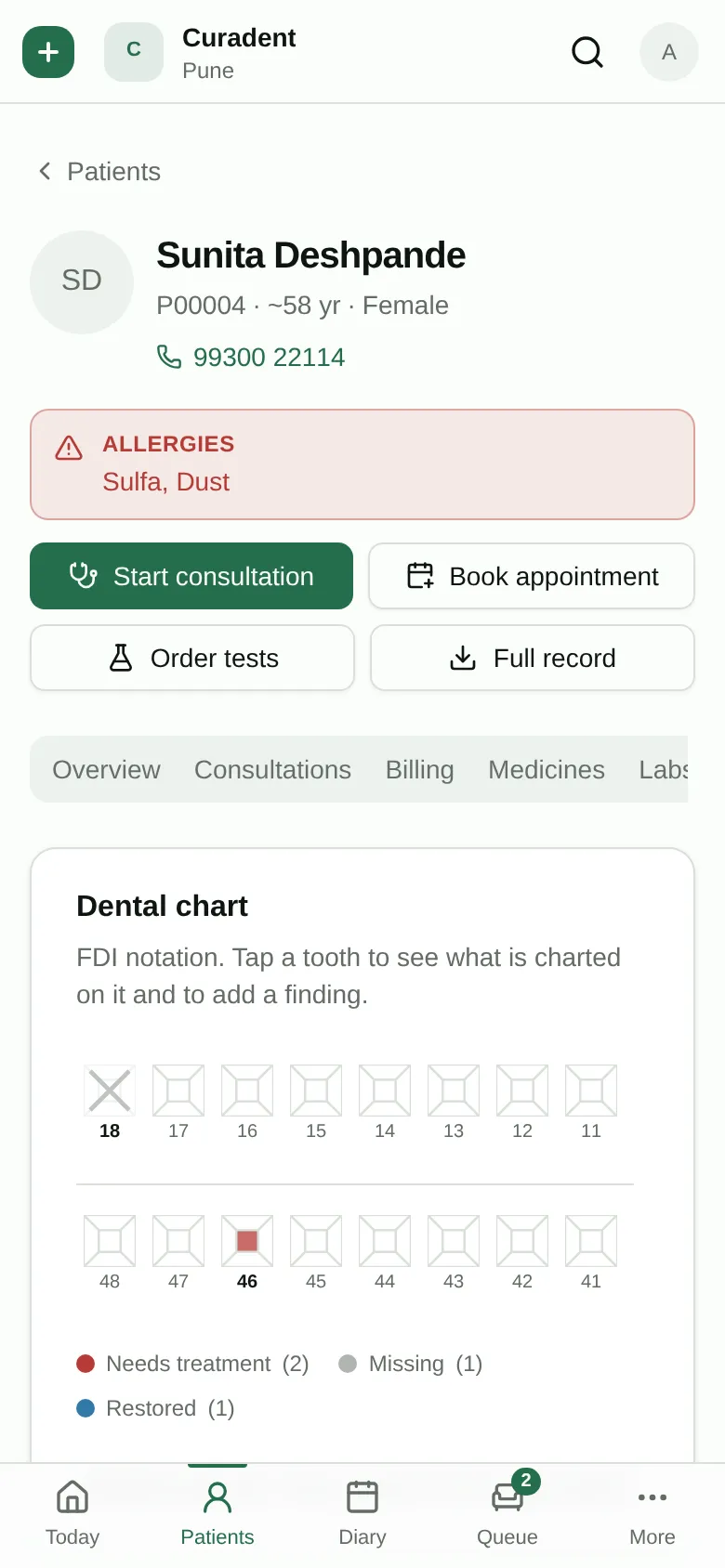
Every tooth in FDI notation, shaded by surface, so a mesio-occlusal caries on 26 reads as two wedges rather than as a sentence somebody has to parse. Mesial faces the midline in every quadrant, which is the detail that tells a dentist whether software was built for them.
Findings open and close on dates, and the chart is computed rather than stored. Ask for March and you get March — which is what a treatment plan quoted in March has to be defended against in November.
A plan is proposed, then accepted or declined, with the reason recorded. Accepting opens the work on the dentist’s list without anyone re-typing it. The gap between quoted and accepted is the most useful number in a dental practice and nobody with a paper plan can tell you what it is.
A root canal is three visits and one fee. Nothing is invoiced per sitting, because a root canal abandoned after the first visit is not a third of a root canal — and a practice that has already billed it is having a refund conversation instead of taking a payment.
Six sites on every tooth, with bleeding, plaque, recession and mobility. Attachment loss is computed from probing depth and recession, and the screen names the sites that moved by two millimetres or more — because a mean that holds at 3mm while one pocket goes to 7mm is the mean hiding the only thing that mattered.
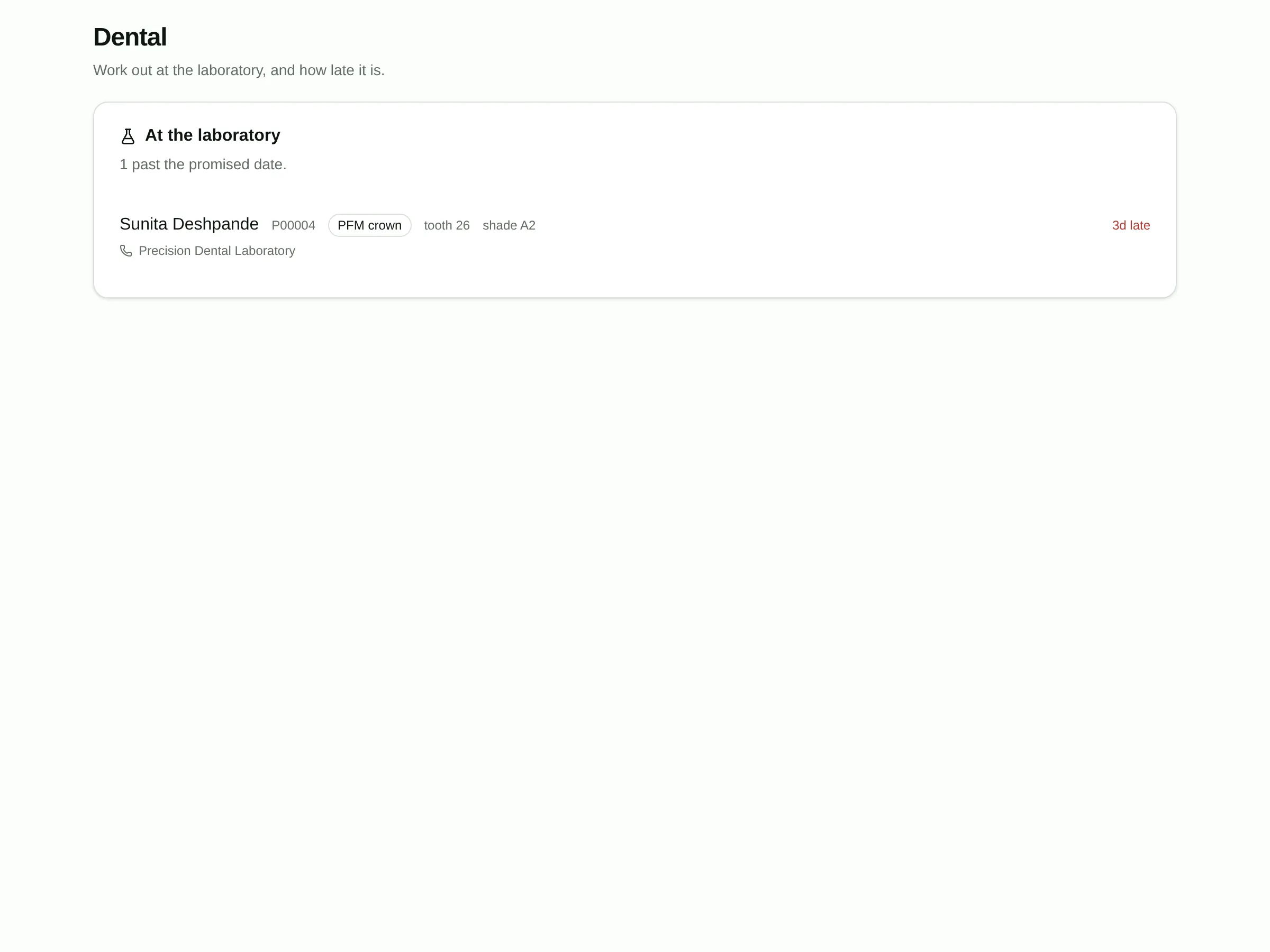
Work sent to an outside laboratory, tracked by the date it was promised, with the shade and the teeth it spans. A crown that is late is a patient booked on Thursday with nothing to fit, and it is the commonest way a dental appointment is wasted.
The number nobody has
Every plan carries what it was worth and what the patient answered, so acceptance is a figure rather than a feeling — and the reasons people decline are written down instead of being remembered differently by everyone.
And it is the whole clinic underneath: appointments, GST billing, patient messaging and reports are the same ones every other practice gets. Chairs are bookable, and the diary refuses to put two people in one.
Tooth numbering is FDI two-digit notation (ISO 3950), and findings carry an ICD-10 code from the oral cavity chapter where one applies. The seeded procedure list and its codes are a starting point for a practice rather than a coding standard — price them and check them against your own work before relying on them.
Built for Indian practices
The awkward parts of running a clinic here — GST on a consultation, a WhatsApp reminder, a thermal receipt, a patient with no email address — are handled in the product, not worked around in it.

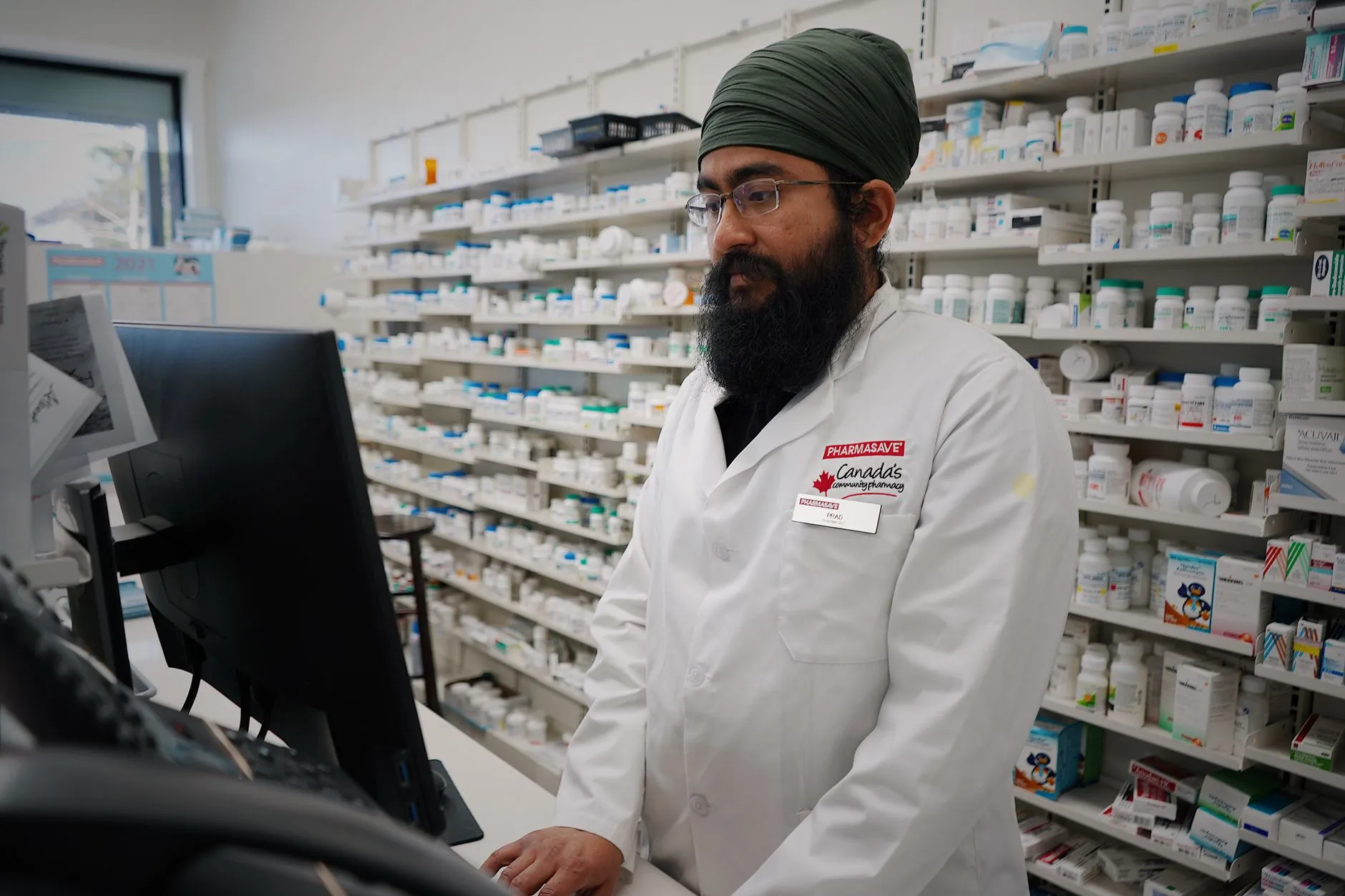
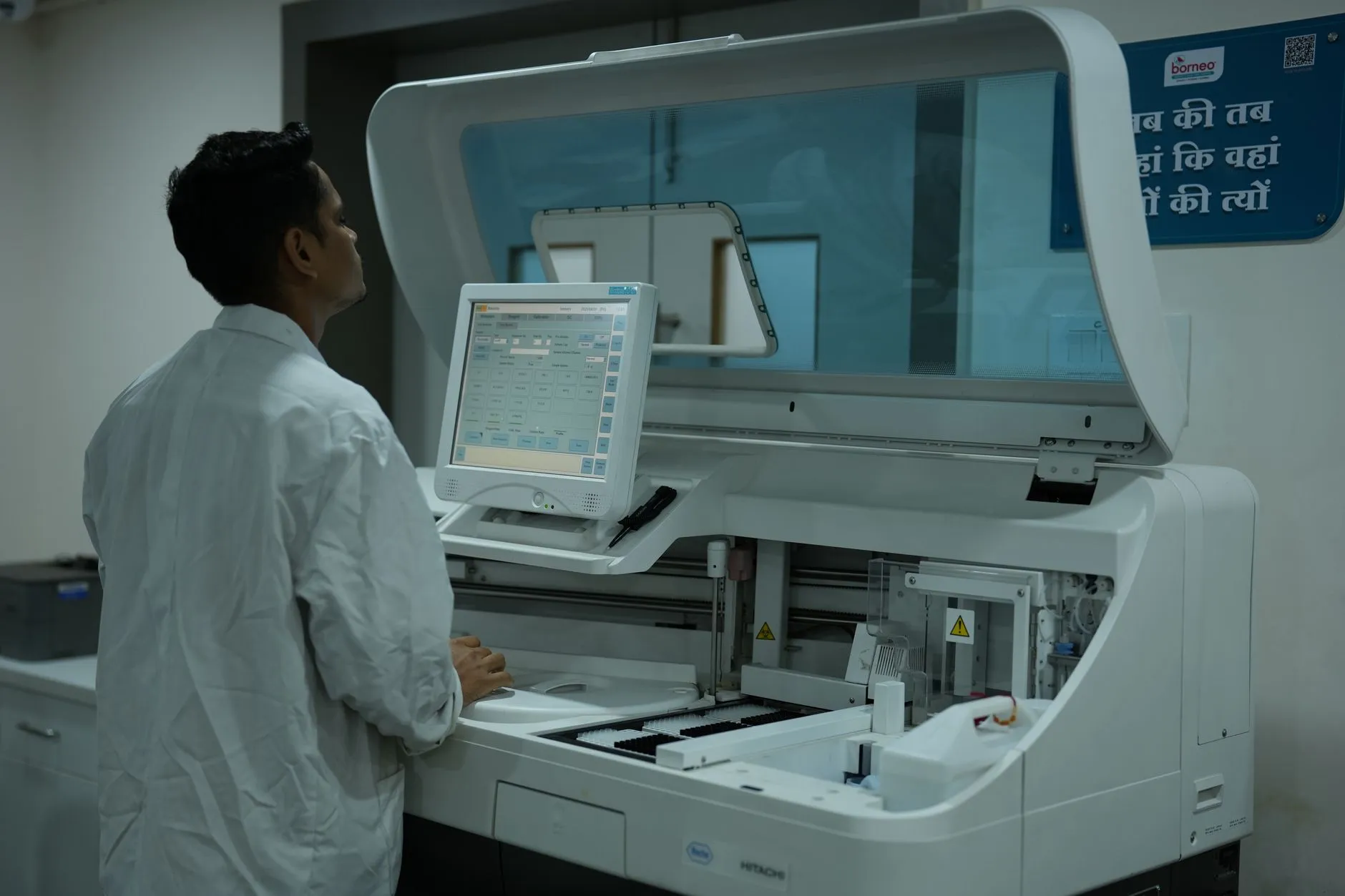
Trust
Two questions matter more than a badge on a page: can anyone else see this, and can anyone change it without leaving a trace. Here are the answers.
Isolation is enforced by the database itself with row-level security, forced even for the table owner — not by a WHERE clause somebody might forget. A test suite of 200+ assertions runs against every change to prove it.
A signed consultation, an issued invoice and a verified lab report are frozen by the database. Corrections are new, dated entries. Who changed what is recorded in an audit trail nobody can edit.
A receptionist books and bills. A doctor consults and prescribes. A pharmacist dispenses. Roles are checked on the server, so hiding a button is not the security model.
Export patients, visits, invoices and stock as CSV at any time, from inside the app. There is no retention hostage-taking and no export fee.
One button produces a single patient’s whole record for a DPDP access request. Consent is a dated record per purpose, not a checkbox, and withdrawing adds a record rather than erasing one.
Capture a patient’s ABHA number at registration and it is checked, stored and exported with everything else — so linking records under ABDM later is a switch rather than a data-entry project.
Pricing
Every plan includes unlimited patients, unlimited visits, every person on your team who needs a login, and the whole base clinic. You pay for pharmacy and labs, and nothing else.
Your speciality module is included on every plan, and is chosen once.
A single doctor and a front desk.
₹999/ month
Solo practice · Up to 3 people
Start 14 days freeA clinic that also dispenses medicine.
₹2,499/ month
Multi-doctor clinic · Up to 10 people
Start 14 days freeA polyclinic with its own lab.
₹5,999/ month
Polyclinic · Unlimited people
Start 14 days freePrices exclude GST. Cancel from inside the app at any time — no phone call, no notice period.Compare plans in full
An afternoon. Create the clinic, add your doctors, and start seeing patients — the diary, queue and billing work out of the box. Pharmacy and labs need your item list and panels, which is the only real setup.
Yes. Import patients from a CSV export of your current system or your existing spreadsheet. Write to [email protected] with a sample and we will map the columns with you.
The app keeps working on what is already loaded and reconnects on its own. Nothing is written twice when it comes back, because every save is idempotent on the server.
Yes, and you should — prescriptions and signed notes carry the doctor who wrote them. Seats are included in the plan price; there is no per-user surcharge inside your limit.
Each branch is its own clinic with its own records, and one login can switch between them from the sidebar. Reporting is per clinic today.
Your records stay intact and readable, and you can export everything. Paid modules switch off; nothing is deleted.
From the blog
 BuyingHow much does clinic management software cost in India?Expect ₹1,000–₹6,000 a month per clinic for cloud software that covers appointments, consultations and billing, with pharmacy and labs adding to that. One-time on-premise systems still exist at ₹25,000–₹1,50,000, but you pay separately for updates, backups and support.Read it
 Billing & GSTDo clinics have to charge GST on consultations and medicines?Healthcare services by a clinical establishment are exempt from GST, so a consultation is not taxed. Selling medicines and consumables over the counter is a supply of goods and is taxable at the rate for that item, which is why one visit can produce an exempt line and a taxable line on the same bill.Read it
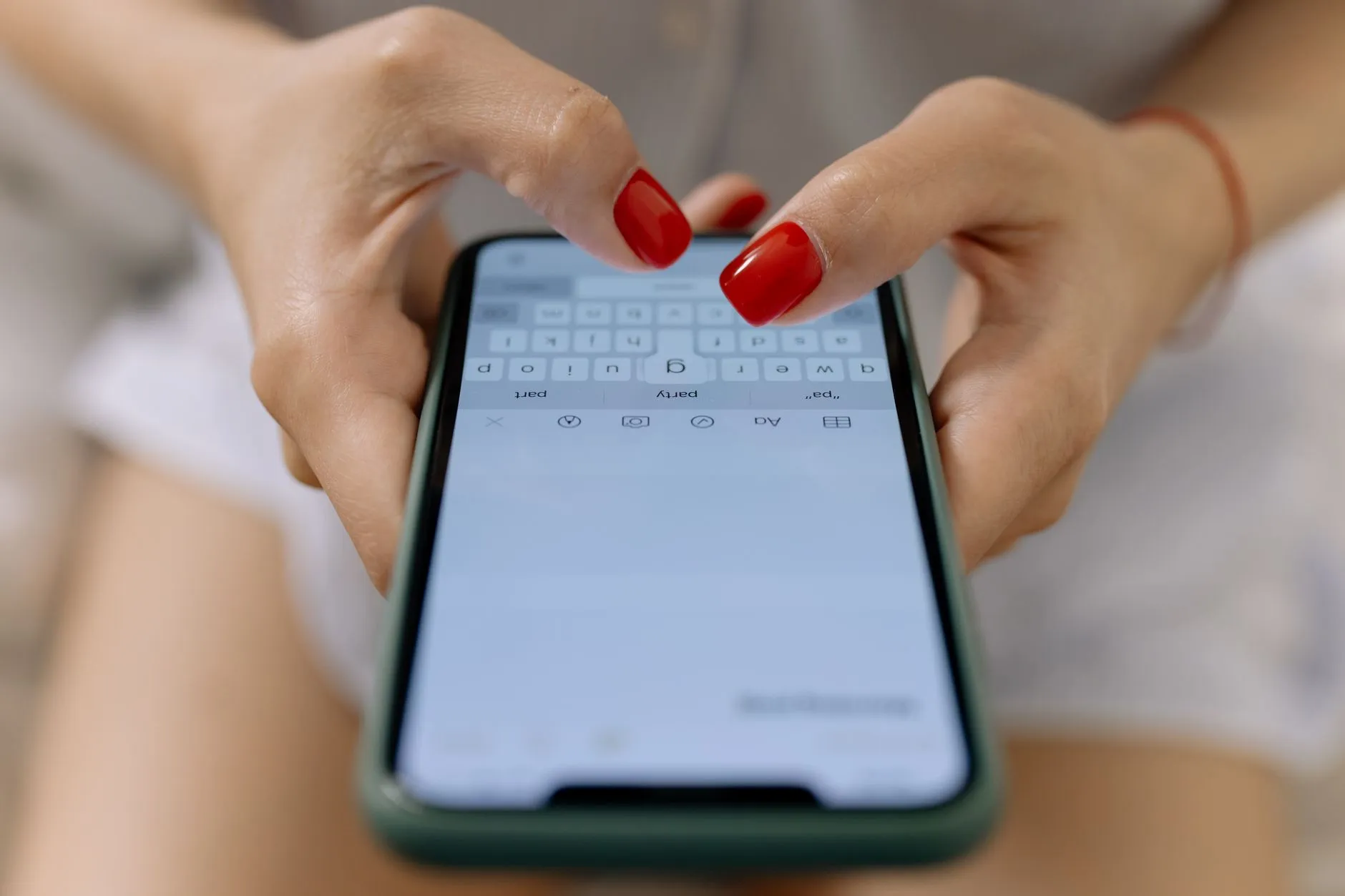 PatientsCan a clinic send appointment reminders on WhatsApp?Yes, through the WhatsApp Business Platform, using message templates approved in advance and only to patients who have opted in. Reminders sent 24 hours and again 2 hours before the slot are what measurably cut no-shows; anything more reads as spam and earns opt-outs.Read it
Fourteen days free, every module switched on, no card. If it does not fit how your clinic works, walk away with your data.